
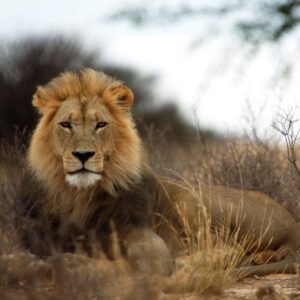
Beyond the Roar: What World Lion Day Should Mean for India
Every August 10, World Lion Day offers the world an opportunity to celebrate one of its most recognisable wild animals. But the significance of the day should extend beyond photographs of magnificent lions and familiar images of the Gir landscape. It should prompt a more difficult question: what does it really take to ensure that a species survives in a world increasingly shaped by roads, farms, industries, climate change and expanding human settlements?
For India, this question has acquired particular importance. The Asiatic lion is not merely a symbol of Gujarat or a celebrated component of India’s wildlife heritage. It is the sole surviving wild population of the Asiatic subspecies and, therefore, represents an extraordinary conservation responsibility.
There is reason for optimism. India’s lion population increased from 674 in 2020 to 891 in 2025, a rise of more than 32%. The 2025 population estimation also recorded an expansion in the species’ distribution and the emergence of satellite populations beyond the traditional Gir stronghold. Barda Wildlife Sanctuary has begun to develop as another important habitat. These developments demonstrate that sustained conservation, scientific monitoring and community participation can produce measurable results.
But population growth should not become an excuse for complacency.
The history of the Asiatic lion is a reminder of how quickly ecological security can disappear. Once distributed across large parts of Asia, the species was driven to the brink of extinction by hunting and habitat loss. Its survival in Gujarat is one of conservation’s notable successes, but its present concentration also represents a vulnerability. A disease outbreak, natural disaster or ecological disturbance affecting a geographically concentrated population could have consequences far beyond the immediate landscape.
This is why the future of the Asiatic lion cannot be reduced to protecting individual animals. It requires protecting landscapes.
The 2025 estimation is significant not only because it counted 891 lions but also because it recorded their movement into new areas, including forested zones, river corridors and revenue wastelands. Such expansion makes ecological connectivity increasingly important. Corridors that allow lions to move between habitats must be protected from incompatible infrastructure and unplanned development. A landscape that appears empty on a map may be critical to wildlife movement.
Equally important is the relationship between lions and the communities living around them. Conservation cannot succeed if local residents perceive wildlife protection as a burden imposed from outside. Gujarat’s experience demonstrates the importance of local participation in protecting the lion landscape. Farmers, pastoralists, forest workers, women’s groups, trackers and local communities are not peripheral actors in conservation; they are its everyday custodians.
Human-wildlife conflict must therefore be treated as a conservation issue, not merely a law-and-order problem. As lions move into new territories, encounters with livestock and people are likely to increase. Compensation for livestock losses, rapid response mechanisms, veterinary support, public awareness and scientific monitoring must keep pace with the expanding population. The objective should be coexistence, not simply conflict management after an incident occurs.
There is also a larger ecological lesson. Apex predators are indicators of the health of ecosystems. Their survival depends upon functioning food chains, adequate prey, water availability, healthy grasslands and connected habitats. Protecting the lion consequently means protecting an entire ecological system. In an era of climate uncertainty, such resilient ecosystems are assets not only for wildlife but also for human communities.
India’s Project Lion has rightly adopted a landscape-based approach, including habitat restoration, community participation and disease preparedness. The next stage should deepen this approach. Greater investment is needed in veterinary infrastructure, genetic and disease research, habitat connectivity, ecological monitoring and climate-risk assessment. Conservation planning must also anticipate the consequences of infrastructure expansion rather than respond to them after habitats have already been fragmented.
World Lion Day should therefore be less about celebrating the “king of the jungle” and more about reconsidering what conservation means. The lion does not need our admiration nearly as much as it needs ecological space.
India has demonstrated that a species once pushed towards extinction can recover. The challenge now is to ensure that recovery does not create a new form of vulnerability through excessive concentration, habitat fragmentation or conflict with communities.
The roar of the Asiatic lion is a sound of conservation success. But it should also be a reminder of responsibility. A truly successful conservation programme will not merely produce more lions. It will create landscapes in which lions, prey species, forests, grasslands and people can continue to coexist.
That is the deeper significance of World Lion Day: not simply to save the lion, but to preserve the ecological conditions that make its existence possible.
Siddharth Roy
Guwahati, Assam