
The Sacredness of Making: What Vishwakarma Puja Means Today
Every year, when Vishwakarma Puja arrives, factories fall briefly silent, workshops are cleaned, tools are arranged with unusual care, and machines that normally disappear into the background of everyday life become objects of reverence. A spanner, lathe, welding machine, computer, crane or engine acquires a significance beyond its utility. For a day, those who work with their hands and minds pause to acknowledge something modern economies often forget: civilisation is built by people who make things.
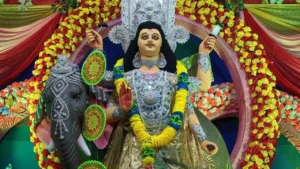
Vishwakarma, revered in Hindu tradition as the divine architect and craftsman, represents more than a deity associated with tools and machines. He embodies an older Indian idea that creation is itself a sacred act. The world is not merely inhabited; it is continuously constructed, repaired, shaped and improved. Vishwakarma Puja therefore offers an unusual bridge between spirituality and work. It asks us to consider not only what we produce, but the attitude with which we produce it.
This matters in an age in which the vocabulary of work has become increasingly detached from the physical world. India speaks of infrastructure, manufacturing, artificial intelligence, automation, smart cities and technological transformation. Yet behind every bridge is an engineer who calculated its loads, a worker who assembled its components, a technician who maintained its machinery and countless others whose labour rarely enters the public imagination.
Vishwakarma Puja restores visibility to this invisible chain of creation.
Its significance is particularly striking for an engineering profession. Engineering is often described as the application of science and mathematics to practical problems. But good engineering is also an ethical discipline. A structure must not merely stand; it must stand safely. A road must not merely be inaugurated; it must remain usable. A machine must not merely function; it must function without placing workers at unnecessary risk. Design carries consequences, and therefore every act of making carries responsibility.
The spirit of Vishwakarma Puja can consequently be understood as a reminder that tools are never morally neutral in the hands of their users. A crane can build a bridge or become dangerous through negligence. A computer can expand human capability or facilitate deception. Artificial intelligence can assist discovery while also amplifying error. Technology magnifies intention; it does not replace responsibility.
There is another lesson embedded in the festival: respect for maintenance.
Modern societies tend to celebrate creation more enthusiastically than upkeep. New highways attract ceremonies; routine road repairs rarely do. New buildings are inaugurated with ceremony; structural inspections are largely invisible. A new machine represents progress; maintaining an ageing machine is considered ordinary work. Yet the safety and longevity of civilisation depend as much on maintenance as invention.
This is where the symbolism of worshipping tools becomes profound. To place a tool before Vishwakarma is, in a sense, to acknowledge dependence on it. It is to recognise that the instruments through which human beings transform the world deserve care. The ritual of cleaning machinery before the puja contains an idea that modern infrastructure policy could learn from: what we value, we maintain.
The festival also speaks to the dignity of labour. India has historically struggled with hierarchies that have divided intellectual work from manual work. The engineer, architect and designer are often celebrated, while the welder, mechanic, mason, electrician and machine operator remain anonymous. Vishwakarma Puja, at its best, challenges this hierarchy by placing the instruments of all forms of productive labour within the same sacred frame.
Its message is not that every occupation is identical. Rather, it is that creation itself deserves respect.
This becomes particularly important as India seeks to expand manufacturing and build large infrastructure networks. A country cannot become a manufacturing power merely by acquiring machines. It needs skilled workers, vocational education, safe workplaces, technical institutions and a culture that respects craftsmanship. The demographic promise of India will remain incomplete if millions of young people are encouraged to seek only white-collar employment while skilled technical work is treated as socially inferior.
The future will also test the meaning of Vishwakarma in another way. As automation and artificial intelligence change the workplace, the relationship between humans and machines will become increasingly complex. The old distinction between the person who works and the tool with which they work is already blurring. Yet the fundamental principle remains: machines may transform labour, but human beings remain responsible for deciding what should be built and for whom.
Perhaps this is the deepest meaning of Vishwakarma Puja.
It is not simply a festival of machines. It is a festival of human creativity — and of the responsibility that accompanies the power to create.
A bridge, a building, a machine, a piece of software or a work of art begins as an idea before becoming an object in the world. Vishwakarma reminds us that the distance between imagination and reality is crossed through labour, skill and discipline.
In worshipping the tools of creation, we are ultimately acknowledging the creators themselves.
And in an age obsessed with speed, scale and novelty, perhaps the most valuable lesson of Vishwakarma Puja is a quieter one: to make something well is not merely to produce. It is to serve, to care and to leave the world a little more durable than we found it.
Siddharth Roy
Guwahati, Assam