
The Life and Legacy of Mahapurush Madhabdev: A Beacon of Assam’s Bhakti Movement
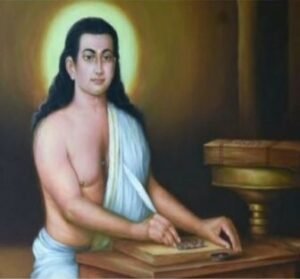
On the sacred occasion of Madhabdev Tithi, Assam pauses to pay homage to Mahapurush Madhabdev i.e. the torchbearer of the Ekasarana Dharma, an extraordinary poet, a master composer, and the foremost disciple of Srimanta Sankardeva. Madhabdev was not merely a spiritual reformer; he was the architect who consolidated and systematized the Neo-Vaishnavite movement, embedding it permanently into the socio-cultural fabric of Assam.
Born in 1489 at Letekupukhuri in present-day Lakhimpur district, Madhabdev’s early life was marked by hardship, continuous travel, and rigorous traditional scholarship. Deeply learned in the scriptures, he initially practiced Sakta traditions with unyielding conviction. However, a turning point arrived in 1522 during a famous historical debate with Srimanta Sankardeva at Belaguri. Intending to defend his Sakta rites, the young scholar engaged in a fierce theological debate. Sankardeva’s profound philosophy of single-minded devotion to Lord Krishna (Ekasarana) and his mastery over the scriptures transformed Madhabdev. Deeply moved, Madhabdev surrendered his former beliefs and accepted Sankardeva as his spiritual guide. This transformative encounter is revered in Assamese history as the Mani-Kanchan Samyog—the divine union of the jewel and gold.
From that historic moment, Madhabdev dedicated his entire life to serving his guru and advancing the Neo-Vaishnavite revolution. Unlike the rigid caste hierarchies and complex rituals prevalent at the time, this movement preached a egalitarian philosophy accessible to all sections of society through the simple path of Nām-Kīrtan (chanting the names of God).
When Sankardeva passed away in 1568, the mantle of guiding the faith fell upon Madhabdev. He led the community with exceptional administrative foresight and spiritual clarity. Under his guidance, the institutional framework of the Satra (monasteries) and Namghar (community prayer halls) flourished. He established the historical Barpeta Satra, transforming it into a radiant seat of learning, culture, and devotional art.
Madhabdev’s contribution to Assamese literature and music remains unmatched. He was a literary genius whose writings resonated with both profound philosophy and deep human emotion. His magnum opus, the Nam-Ghosha (also known as the Hajari Ghosha), contains one thousand verses of exquisite poetry detailing divine grace, humility, and spiritual realization. It serves as a spiritual lighthouse for millions.
Additionally, his Bhakti-Ratnavali translated complex devotional tenets into accessible literature. Beyond formal treatises, Madhabdev enriched the cultural landscape through his Borgeets (devotional classical songs) and Ankiya Nats (one-act plays). While Sankardeva’s compositions often focused on the majestic aspect of the Lord, Madhabdev’s Borgeets uniquely captured the tender, childlike playfulness of Young Krishna (Balgopal) and the profound grief of separation (Viraha), weaving intense emotional resonance into classical ragas. Plays like Chor-Dhara and Pimpara-Guchua reflect his unmatched ability to depict divine sweetness through everyday human expressions.
Despite facing intense socio-political pressures and royal persecution during his lifetime, Madhabdev remained a steadfast advocate of peace, harmony, and egalitarian values. He spent his final years in Cooch Behar under the patronage of King Laxminarayan, continuing to write and preach until he attained his journey’s end in 1596.
Centuries later, Madhabdev’s legacy remains vibrantly alive. On his Tithi, as echoes of the Khol, Taal, and soul-stirring Borgeets fill the air of Namghars across Assam and beyond, society reflects not just on a historical icon, but on a perpetual source of moral and cultural strength. Mahapurush Madhabdev taught us that true devotion manifests through humility, service, and the relentless pursuit of social harmony i.e. a message as vital today as it was five centuries ago.
Siddharth Roy
Guwahati, Assam