National Unity Day: Beyond the Celebration, the Work of Holding India Together
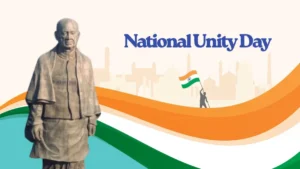
Every year on October 31, India observes National Unity Day, or Rashtriya Ekta Diwas, to mark the birth anniversary of Sardar Vallabhbhai Patel. The day honours a leader whose determination helped bring hundreds of princely states into the Indian Union at a moment when the country could easily have broken apart. Yet remembering Patel should mean more than garlanding his portrait or repeating familiar speeches. It should invite a harder question: what does it take to keep a diverse democracy united today?
At Independence in 1947, India inherited a difficult map. British rule had ended, but more than 560 princely states had to decide their future. As Deputy Prime Minister and Home Minister, Patel, working closely with V.P. Menon and other officials, used negotiation, political judgement and, where necessary, firmness to secure accession. The integration of these states was not a minor administrative exercise. It helped give political shape to the country that Indians now call home.
Patel’s achievement was remarkable because unity was not imposed on a blank slate. India was emerging from Partition, accompanied by mass displacement, communal violence and deep uncertainty. Patel’s legacy therefore lies not simply in the territory brought together, but in the resolve to make a functioning union possible.
But a monument can preserve memory; it cannot perform the daily work of national integration. That work happens in classrooms, courts, local administrations, workplaces and neighbourhoods. It depends on whether citizens experience the country as a shared home, rather than as a contest in which one community must lose for another to belong.
India’s diversity is often described as a challenge, but it is also a source of strength. Its languages, cuisines, music, literature and traditions have grown through centuries of exchange. National unity does not require these differences to disappear. Indeed, a demand for cultural sameness would weaken the very idea of India. The Constitution offers a more durable foundation: equal citizenship, fundamental rights, democratic participation and respect for the plural character of the republic. Unity becomes meaningful when people can remain different without becoming unequal.
This principle matters especially in regions that often feel distant from the centres of power. The Northeast, for instance, is not a peripheral footnote to the national story. Its communities, languages, landscapes and histories are integral to India. Yet discrimination, racial stereotyping, inadequate connectivity and a sense of political neglect can make belonging feel conditional. National integration cannot be secured through slogans alone. It requires fair access to education, healthcare, employment and infrastructure, along with respect for local identities and meaningful consultation before decisions are taken.
Economic inequality also tests the bonds of citizenship. A country may record impressive growth, build expressways and attract investment, but unity remains fragile if large sections of its people see few improvements in their lives. Young people without decent work, farmers facing uncertain incomes and families struggling to access public services may feel excluded from the promise of development. Inclusive growth is therefore not separate from national security or social cohesion. It is one of their foundations. A citizen who feels that the republic offers dignity and opportunity has a stronger reason to trust its institutions.
The public conversation presents another challenge. Social media can connect distant communities and bring urgent issues into view. It can also spread rumours, deepen prejudice and turn disagreement into hostility. In a democracy, dissent is not disloyalty. Citizens must be free to question governments, criticise policies and demand accountability. But debate loses its democratic value when it relies on falsehoods, threats or the dehumanisation of opponents. National unity cannot mean silence; it must mean the ability to disagree without treating fellow citizens as enemies.
Institutions have a crucial role in sustaining this balance. The rule of law must apply equally, public services must be impartial, and constitutional rights must be protected without discrimination. Political leaders carry a special responsibility to avoid language that inflames social divisions for short-term advantage. Educational institutions, too, should teach history with honesty and complexity, helping young Indians understand both the achievements and the failures of the past. Patriotism should encourage responsibility, not demand unquestioning agreement.
National Unity Day should also remind us that unity is built through ordinary acts. A neighbour who helps another during a flood, a teacher who welcomes children from different backgrounds, a public official who treats every applicant fairly and a citizen who refuses to forward a hateful rumour all strengthen the republic.
Sardar Patel helped unite a fragmented political landscape at a decisive moment. The task before India today is different, but no less important: to ensure that political unity is matched by social trust, equal opportunity and constitutional fairness. On October 31, the most meaningful tribute to the Iron Man of India would be to look beyond ceremony and ask whether every citizen feels heard, respected and included. A nation is not held together by a map alone. It is held together by the conviction that, despite our differences, we share responsibility for one another and a common future.
Siddharth Roy
Guwahati, Assam