
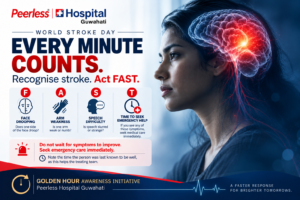
Peerless Hospital Guwahati urges public to recognise stroke symptoms and act FAST under its Golden Hour awareness initiative
Guwahati, Rongili Barta: On World Stroke Day, Peerless Hospital Guwahati renews its call for greater public awareness of stroke symptoms and the importance of seeking immediate medical attention. Continuing its Golden Hour awareness initiative, the hospital emphasises a critical message: recognising a stroke is only the first step; acting without delay can significantly improve treatment outcomes and long-term recovery.
Globally, World Stroke Day 2026 continues the “Every Minute Counts” campaign, drawing attention to the importance of recognising stroke symptoms and acting FAST. The message is particularly relevant because stroke can occur suddenly, and symptoms are sometimes mistaken for fatigue, dizziness or a temporary health issue. Waiting for symptoms to subside or delaying medical consultation can cost valuable treatment time.
“Stroke is a medical emergency in which time directly influences the treatment options available to a patient. We urge people to remember FAST — Face drooping, Arm weakness, Speech difficulty, and Time to seek emergency medical help. If someone suddenly develops any of these symptoms, do not wait to see whether they improve. Seek emergency care immediately. It is equally important to note the time the person was last known to be well, as this information helps the treating team assess the most appropriate course of action,” said Dr. Kurmi Rajesh Kumar, Senior Consultant, Neurology, Peerless Hospital Guwahati.
Dr Kumar highlights that the Golden Hour should be understood as a call for urgency, rather than a strict cut-off after which treatment is no longer possible. Current clinical guidelines recommend rapid assessment and treatment for eligible patients with acute ischaemic stroke. Intravenous thrombolysis may be appropriate for eligible patients within the established 4.5-hour window, while selected patients may qualify for treatment beyond this period following specialised brain imaging. Mechanical thrombectomy, a procedure used to remove a clot from a blocked major blood vessel, may also be beneficial for appropriately selected patients, including some who arrive as late as 24 hours after they were last known to be well.
“These treatment options are not suitable for every patient, and eligibility depends on clinical evaluation, imaging findings and other individual factors. Nevertheless, the possibility of treatment beyond the initial hours makes one message especially important: never assume it is too late to seek help. Every suspected stroke requires immediate medical assessment,” Dr Kumar added.
The hospital also advises the public not to give a person with suspected stroke food, drinks or medication, including aspirin, unless instructed by a medical professional. Stroke can result from either a blocked blood vessel or bleeding in the brain, and the appropriate treatment depends on the diagnosis. Prompt medical evaluation is essential to distinguish between these conditions and guide treatment safely.
Commenting on the significance of World Stroke Day, Dr. Pranab Barua, CEO, Peerless Hospital Guwahati, said, “World Stroke Day reminds us that awareness, timely action and access to appropriate healthcare are essential to improving outcomes for people affected by stroke. We believe that empowering communities with the right information can help individuals make informed decisions during medical emergencies. At Peerless Hospital Guwahati, we remain committed to promoting health awareness and encouraging a culture in which seeking timely medical attention is recognised as a vital step towards better health and well-being.”
Through its continued Golden Hour awareness initiative, Peerless Hospital Guwahati aims to encourage individuals, families and communities to recognise warning signs, respond promptly and understand the importance of accessing appropriate emergency care. Greater awareness among family members and bystanders can help reduce delays between the onset of symptoms and hospital assessment.