
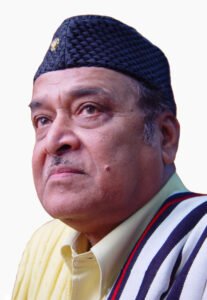
The Voice of the River: Bhupen Hazarika at 100
On September 8, 1926, on the banks of the mighty Brahmaputra in Sadiya, a voice was born that would redefine the cultural, social, and humanistic contours of modern India. Today, as Assam and the nation mark the birth centenary of Bharat Ratna Dr. Bhupen Hazarika, the occasion is not merely a memorial exercise; it is a reaffirmation of a artistic force whose resonance effortlessly breached geographical, linguistic, and political boundaries. Widely revered as the Sudhakantha and the “Bard of the Brahmaputra,” Hazarika was far more than an extraordinary balladeer. He was a cultural bridge-builder, a fiery public intellectual, and a champion of universal humanism whose artistic canvas embraced the world.
Hazarika’s art was rooted deep within the red soil and blue hills of Assam. From the rhythmic folk traditions of the Bodos, Karbis, and Misings to the classical spiritual devotion of Srimanta Sankardeva’s Borgeet, his early musical identity absorbed the multi-ethnic synthesis of the Northeast. Yet, what rendered his music truly revolutionary was its capacity to translate hyper-local realities into global moral dilemmas. When he sang of the untamed, volatile Brahmaputra—famously questioning the river’s silent indifference to human suffering in Bistirno Parore—he transformed a regional geography into a universal metaphor for social inequity and apathy. Modeled conceptually after Paul Robeson’s Ol’ Man River, Hazarika’s adaptation illustrated his rare instinct to align the struggles of the working class along the Brahmaputra with global civil rights movements.
This internationalist perspective was shaped early during his doctoral studies at Columbia University in the early 1950s. Exposed to anti-colonial movements, civil rights activism, and global folk traditions, Hazarika cultivated a worldview that saw art as an instrument of social justice and peace. Returning to India, he integrated this global consciousness into the indigenous ethos. His friendship with Robeson, his association with the Indian People’s Theatre Association (IPTA), and his deep engagement with the socio-political struggles of his time infused his compositions with a distinct brand of empathetic humanism. Songs like Manuhe Manuhor Babe (If man does not care for man, who will?) transcended regional dialects, becoming immortal anthems of solidarity across South Asia.
It is this universal ethical core that powered his extraordinary fandom, both nationally and across international borders. Long before globalized media created cross-border pop culture, Hazarika’s voice had achieved a legendary, almost mythical status in Bangladesh. During the 1971 Liberation War, his immortal track Jai Jai Naba Jata Bangladesh (Victory to the newborn Bangladesh) served as an inspiring moral backdrop for millions fighting for freedom. Across the eastern border, he was not viewed as a singer from a neighboring state, but as a shared cultural conscience—a testament to his belief that melody needs no passport.
Within India, Hazarika accomplished a rare cultural feat: he brought the artistic heritage of India’s Northeast into the heart of the national mainstream. In West Bengal, his Bengali compositions, created in close collaboration with legendary artists, turned him into an household name whose popular appeal rivaled local stalwarts. His entry into Hindi cinema brought the haunting cadence of Northeastern folk music to audiences across the country. In films like Rudaali, his haunting score—featuring the iconic Dil Hoom Hoom Kare—showcased his uncanny ability to evoke deep, visceral human emotion through minimalist folk structures. Through his music, cinema, and commentary, he single-handedly dismantled the cultural insulation that had long separated the Northeast from the rest of the country.
Hazarika’s legacy offers a vital roadmap for contemporary society. At a time when public discourse is increasingly fragmented by insular identities and ideological divides, his life’s work serves as a powerful reminder of art’s capacity to unite. He saw the artist not as an isolated aesthetician, but as an active participant in nation-building and social reform. His compositions never shied away from confronting poverty, prejudice, or political failure, yet they were never cynical; they remained fundamentally anchored in hope, compassion, and communal harmony.
As his centenary year is observed from Guwahati to New Delhi and Kolkata, the nation pays tribute to an artist who embodied the soul of his homeland while speaking to the conscience of humanity. Dr. Bhupen Hazarika showed that to be truly global, one must first be authentically rooted. A century after his birth, his songs continue to flow like the Brahmaputra—ever-present, life-giving, and forever sweeping across borders.
Siddharth Roy
Guwahati, Assam