
The Pluralist Ethos of Karam Puja
Every autumn, as the monsoon retreats and the fields stand heavy with the promise of harvest, a quiet yet profound transformation sweeps through the agrarian stretches of eastern India and the lush tea gardens of Assam. It is the arrival of Karam Puja—a vibrant, nature-centric festival celebrated on Bhado Ekadashi that transcends mere ritual, emerging as an enduring manifesto of ecological reverence, social cohesion, and living history.
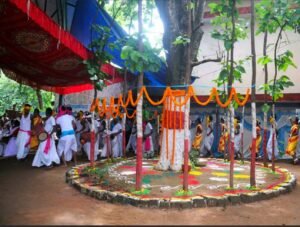
At the heart of the celebration stands the Karam tree (Nauclea parvifolia), revered not as a distant object of worship, but as a living manifestation of Karam Devta—the deity of strength, youth, fertility, and righteous labor. In the days leading to the festival, young unmarried women cultivate Jawa, which are baskets filled with germinating seeds of grains like rice, corn, and pulses. Carefully tended over several days, these sprouting seeds represent life’s fragile beginnings and the collective hope for a bountiful yield. On the day of the main puja, young villagers venture into the forest, cutting a sacred branch from the Karam tree with utmost veneration. The branch is brought to the center of the village courtyard, planted in a freshly prepared floor, and decorated with vibrant flowers and grain offerings.
Under the night sky, as the deep, rhythmic pulse of the madal, dhol, and taal echoes across the settlement, the community comes together in the joyous Jhumur dance. Hand in hand, men and women form circular chains, swaying to the cadence of ancient folk ballads. These songs, passed down orally across generations, are far more than musical entertainment; they are living repositories of history, carrying tales of moral duty, agrarian wisdom, and the timeless struggles of human existence.
The true significance of Karam Puja lies in its multifaceted identity and its deep social relevance. Long before global discourses on environmental sustainability emerged, indigenous communities embedded conservation directly into their spiritual life. Karam Puja does not position humanity above nature, but within it. Worshiping the branch of a wild tree serves as a solemn acknowledgment that human survival is inextricably linked to the well-being of forests, soil, and water systems.
Furthermore, the festival serves as a crucial bridge for preserving ancestral memory. For the tea-tribe communities of Assam—whose ancestors were displaced during the colonial period from regions across Chota Nagpur, Jharkhand, Odisha, and West Bengal—Karam Puja remains an irreplaceable cultural anchor. Amidst the harsh realities of historical migration and arduous plantation labor, preserving this ritual allowed them to retain their identity, dignity, and spiritual roots across generations.
Central to the festival’s spiritual core is the recitation of the myth of Karma and Dharma, two brothers whose divergent paths demonstrate that genuine spiritual fulfillment cannot be achieved by abandoning duty or labor. The story reaffirms that work is worship, and that ethical conduct toward one’s fellow human beings is inseparable from devotion to the Divine.
In an era increasingly characterized by climate instability, rapid urbanization, and social fragmentation, the worldview embedded within Karam Puja offers a vital corrective. It reminds us that economic prosperity divorced from environmental consciousness is fundamentally unsustainable. In diverse regions like Assam and Jharkhand, the festival illuminates the richness of India’s pluralistic cultural landscape, demonstrating how different heritage streams weave together to form a resilient collective ethos.
As the sacred Karam branch is immersed in the river at dawn, returning to the waters that nourish the soil, it leaves behind an enduring lesson. Karam Puja is not merely a seasonal relic of the past; it is a living, breathing blueprint for a more harmonious future—one where humanity walks gently upon the earth, honors the dignity of labor, and finds joy in the shared rhythm of community life.
Siddharth Roy
Guwahati, Assam