
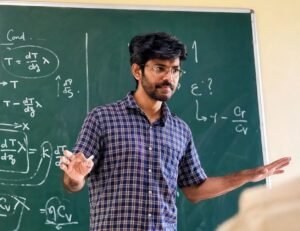
Pride of Assam: Dr. Atanu Nath at the Frontiers of Global Physics
Heramba Nath
In an age defined by rapid technological acceleration and unprecedented scientific collaboration, the geography of knowledge is often assumed to be concentrated within a few global epicentres—Silicon Valley, Geneva, Cambridge, or Tokyo. These locations dominate the imagination of modern science, appearing as the natural habitats of discovery and innovation. Against this backdrop, the recognition of Dr. Atanu Nath with the prestigious Breakthrough Prize in Fundamental Physics in 2026 emerges not merely as a personal achievement, but as a deeply symbolic moment that disrupts these assumptions. It reorients the map of intellectual possibility, drawing attention to the often-overlooked scientific potential of India’s Northeast, particularly Assam.
The Breakthrough Prize, frequently described as the “Oscars of Science,” is not simply another accolade in the long list of scientific honours. It represents a celebration of ideas that push the boundaries of human understanding, that dare to question the known and venture into the unknown. Founded to recognise transformative contributions in fundamental physics, life sciences, and mathematics, the award carries both prestige and philosophical weight. It honours those who stand at the edge of human knowledge, peering into the mysteries that define existence itself. That Dr. Nath, a scientist rooted in the soil of Assam, has become part of this global narrative is an event of both intellectual and cultural importance.
His contribution is closely associated with the Muon g-2 experiment, one of the most ambitious and intricate experiments in modern particle physics. Conducted through a collaborative effort spanning multiple continents, the experiment involves leading institutions such as CERN, Brookhaven National Laboratory, and Fermilab. These are not merely laboratories; they are arenas where humanity confronts its deepest questions about the nature of reality.
At its core, the Muon g−2 experiment explores the behaviour of the muon, a subatomic particle that resembles the electron but possesses a much greater mass. According to the Standard Model of particle physics, the muon’s magnetic moment—its intrinsic interaction with a magnetic field—should follow precise theoretical predictions. For decades, this framework has stood as one of the most successful achievements of modern physics, accurately describing the fundamental particles and forces that constitute the universe.
Yet, science thrives on anomalies. The Muon g−2 experiment has revealed slight but persistent discrepancies between the predicted and observed values of the muon’s magnetic moment. These deviations, though minute in scale, are monumental in implication. They suggest that there may be forces or particles that lie beyond the Standard Model—elements of reality that have not yet been discovered or understood. Such a possibility is both thrilling and unsettling, as it challenges the completeness of our most trusted theories.
Within this complex scientific endeavour, Dr. Nath’s role becomes part of a larger tapestry of collaborative inquiry. He is among 376 scientists worldwide, including around 11 Indians, who share this honour. This collective recognition underscores a fundamental truth about contemporary science: that it is inherently collaborative. The age of solitary genius has given way to an era of interconnected intellects, where discoveries emerge from networks of researchers working across borders, languages, and disciplines.
However, within this vast global network, the presence of a scientist from Assam carries a unique resonance. It speaks to the silent resilience of a region that has long remained on the periphery of India’s scientific infrastructure. It reflects the aspirations of countless young minds who pursue education and knowledge despite limited resources and opportunities.
Born in Lalabazar in the Hailakandi district of Assam, Dr. Nath’s journey is as compelling as the science he engages with. The Barak Valley, with its serene landscapes and cultural richness, is not typically associated with cutting-edge scientific research. Yet, it is from this very environment that a mind capable of contributing to one of the world’s most sophisticated experiments has emerged. His story challenges the assumption that excellence must originate from elite institutions or urban centres. It affirms that intellectual brilliance can arise from any corner of the world, given the right combination of curiosity, determination, and perseverance.
Currently serving as an Assistant Professor at Tihu College in Nalbari, Dr. Nath embodies a rare and significant duality. He is both a participant in global scientific discourse and a mentor within a regional academic setting. This dual role is not merely a professional arrangement; it is a philosophical statement. It suggests that knowledge need not be confined to centres of power but can circulate, returning to enrich the communities from which it originates.
For students in Assam and across the Northeast, his presence in a local institution is profoundly meaningful. It transforms the abstract idea of global scientific achievement into a tangible reality. It offers a living example of what is possible, bridging the gap between aspiration and attainment. In classrooms where resources may be limited, the presence of a teacher who has contributed to world-class research becomes a source of inspiration that no textbook can replicate.
At the same time, this achievement invites a deeper reflection on the structural challenges that continue to shape the landscape of education and research in the region. Despite policy rhetoric emphasising innovation and scientific temper, many institutions in the Northeast struggle with inadequate infrastructure, limited funding, and insufficient exposure to global research networks. Laboratories often lack modern equipment, and opportunities for advanced research remain scarce.
Dr. Nath’s success, therefore, is both a celebration and a critique. It highlights what is possible while also drawing attention to what remains unfulfilled. It raises important questions about how many other talented individuals may be constrained by systemic limitations. It challenges policymakers to move beyond symbolic recognition and invest meaningfully in the development of scientific ecosystems in peripheral regions.
Such investment must go beyond infrastructure. It must include the cultivation of a research culture—an environment where questioning is encouraged, where failure is seen as part of the learning process, and where curiosity is nurtured rather than constrained. Collaboration with international institutions, access to global research platforms, and opportunities for interdisciplinary study can play a crucial role in bridging existing gaps.
The story of Dr. Nath also carries a cultural dimension that is often overlooked in discussions of science. It reminds us that scientific inquiry is not detached from the human experience. It is shaped by context, by upbringing, by the environments in which individuals grow and learn. The journey from Lalabazar to the laboratories of Fermilab is not merely a geographical transition; it is a narrative of transformation, of crossing boundaries both visible and invisible.
In a broader philosophical sense, the implications of the Muon g−2 experiment extend far beyond the confines of particle physics. The possibility that the Standard Model of particle physics may be incomplete invites a rethinking of certainty itself. It suggests that knowledge is not a fixed entity but a dynamic process, constantly evolving as new questions arise and new answers are sought.
This realisation carries profound implications for how we approach education and intellectual inquiry. It encourages a mindset that values curiosity over certainty, exploration over complacency. It reminds us that the pursuit of knowledge is an ongoing journey, one that requires humility as much as it does brilliance.
For Assam, the recognition of Dr. Nath becomes part of a larger narrative of identity and aspiration. It signals a shift in how the region is perceived, both within India and beyond. It challenges stereotypes that have long defined the Northeast as peripheral or marginal. It asserts that the region is not merely a recipient of knowledge but an active contributor to its creation.
The emotional resonance of this achievement is evident in the way it has been celebrated across the state. Educational institutions, students, and the general public have embraced it as a moment of collective pride. It has sparked conversations about science, education, and the future—conversations that are essential for the development of a knowledge-driven society.
Yet, the true significance of this moment lies not in celebration alone but in what follows. Recognition must translate into action. Inspiration must lead to opportunity. The story of Dr. Nath must become a catalyst for broader change, encouraging investment in education, fostering a culture of research, and creating pathways for future generations to engage with science at the highest levels.
As the global scientific community continues to explore the mysteries of the universe, the contribution of individuals like Dr. Nath serves as a reminder that the quest for knowledge is a shared human endeavour. It transcends boundaries of geography, culture, and language. It unites individuals in a common pursuit of understanding, driven by curiosity and sustained by collaboration.
In the quiet classrooms of Tihu College, in the villages of Assam, and in the minds of young students who dare to dream, this achievement will continue to resonate. It will serve as a source of inspiration, a reminder that the boundaries of possibility are not fixed but expandable.
The story of Dr. Atanu Nath is not merely about physics. It is about the power of education, the importance of opportunity, and the resilience of human aspiration. It is about a region finding its voice in the global conversation of science. And above all, it is about the enduring belief that brilliance can emerge from anywhere, illuminating the path for others to follow.