
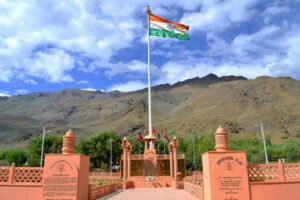
Kargil’s Unfinished Lesson: Remembering Victory, Renewing Vigilance
Siddharth Roy,Guwahati
(The author is a civil engineer, consultant (invitee) to
Rashtriya Raksha Universityunder the
Ministry of Home Affairs and a columnist.
The Views are personal. He can be reached at
siddharth001.roy@gmail.com)
Every nation has moments that define its character. For India, the summer of 1999 remains one such defining chapter. The nation observes Kargil Vijay Diwas on July 26, the day that is often commemorated with wreaths, military parades and stirring tributes to fallen soldiers. These ceremonies are deserved and necessary. Yet, reducing Kargil to an annual ritual risks overlooking its enduring strategic significance. The victory won on the icy heights of Ladakh was not merely a military triumph; it reshaped India’s defence doctrine, altered its strategic thinking and reaffirmed the timeless truth that peace is preserved not by intent alone but by preparedness.
The Kargil conflict unfolded under extraordinary circumstances. Barely a year earlier, India and Pakistan had conducted nuclear tests, prompting fears that South Asia had entered an era of permanent instability. Ironically, diplomatic engagement appeared to be gaining momentum. Prime Minister Atal Bihari Vajpayee’s historic bus journey to Lahore in February 1999 symbolised the hope that political dialogue could replace decades of hostility. But while diplomacy occupied the headlines, Pakistani military planners had already begun executing Operation Badr, a covert plan to infiltrate soldiers disguised as militants across the Line of Control (LoC) into the Kargil sector.
The objective was as audacious as it was dangerous. By occupying the unheld mountain peaks vacated during winter, Pakistan sought to sever National Highway 1A, the critical artery connecting Srinagar with Leh. Such a move would have isolated Indian military positions in Ladakh, altered the tactical balance along the LoC and internationalised the Kashmir dispute. It was a gamble based on the assumption that India would either fail to respond decisively or be constrained by the presence of nuclear weapons.
History proved otherwise.
The first signs of intrusion emerged in early May when local shepherd Tashi Namgyal noticed suspicious movements in the mountains. Initial patrols soon confirmed that well-entrenched Pakistani regulars—not merely irregular militants—had occupied commanding heights overlooking Indian positions. The scale of the intrusion became apparent only gradually, confronting the Indian Army with one of its most formidable military challenges since 1971.
Fighting at altitudes exceeding 16,000 feet demanded extraordinary endurance. Soldiers climbed near-vertical, snow-covered slopes under relentless artillery fire, often at night and carrying equipment weighing over 20 kilograms. The enemy enjoyed the advantage of altitude, fortified bunkers and clear observation of advancing troops. Conventional military logic favoured the defender. Yet the Indian Army chose to fight uphill, literally and figuratively.
Operations at Tololing, Tiger Hill, Point 4875 and numerous other peaks soon became symbols of exceptional courage. Stories of Captain Vikram Batra’s fearless assault on Point 4875, Lieutenant Manoj Kumar Pandey’s determination despite grievous injuries, Grenadier Yogendra Singh Yadav’s astonishing resilience and Captain Anuj Nayyar’s sacrifice continue to inspire generations. These soldiers were not mythical heroes; they were young officers and jawans who displayed uncommon courage under impossible circumstances.
The Indian Air Force’s Operation Safed Sagar added another crucial dimension to the campaign. Operating in rarefied airspace where aircraft performance was severely constrained, the Air Force employed precision strikes while carefully respecting the government’s political decision not to cross the LoC. This restraint was strategically significant. By refusing to expand the conflict, India retained the moral and diplomatic high ground even while prosecuting a determined military campaign.
International opinion increasingly recognised Pakistan as the aggressor. Diplomatic pressure mounted, culminating in Prime Minister Nawaz Sharif’s meeting with U.S. President Bill Clinton on July 4, 1999. Faced with mounting battlefield losses and growing international isolation, Pakistan was compelled to withdraw. By July 26, Indian forces had successfully recaptured the occupied positions, bringing the conflict to a close.
Victory, however, came at a profound human cost. More than 500 Indian soldiers laid down their lives, while many more suffered life-altering injuries. The harsh terrain claimed almost as many casualties as enemy fire. Families across India received folded tricolours instead of sons, brothers and fathers. Kargil thus occupies a unique place in India’s collective memory—not simply because the nation prevailed, but because the price of victory was paid by ordinary citizens in uniform who displayed extraordinary courage.
Yet Kargil Vijay Diwas is not merely about honouring sacrifice; it is about understanding the lessons that emerged from it. The conflict exposed serious shortcomings in intelligence coordination, surveillance and inter-agency communication. The subsequent Kargil Review Committee and the Group of Ministers’ reforms triggered significant changes in India’s national security architecture. Intelligence agencies improved coordination, defence procurement procedures were revisited, the Integrated Defence Staff was established, and surveillance capabilities along sensitive frontiers received greater emphasis. Many of today’s defence reforms trace their origins to the painful introspection that followed Kargil.
The conflict also demonstrated the importance of political clarity during war. India’s leadership combined military resolve with diplomatic restraint, ensuring that the conflict remained geographically limited while mobilising international support. This balance between firmness and responsibility enhanced India’s global credibility and established a template for managing future crises.
Perhaps Kargil’s greatest lesson lies in its reminder that geography never ceases to matter. High-altitude warfare remains an enduring reality for India, as subsequent developments along the northern borders have shown. Modern technology, satellites and drones have transformed surveillance, but mountains still demand constant vigilance, logistical excellence and physically resilient soldiers. National security cannot be seasonal; it must be continuous.
Equally important is the role Kargil played in strengthening public awareness of the armed forces. Television brought the conflict into Indian homes in unprecedented ways. Citizens witnessed not abstract maps but the faces of young officers writing their final letters, soldiers scaling impossible cliffs and families awaiting news with quiet dignity. The emotional bond forged between society and the military during those months continues to shape India’s public consciousness.
Twenty-seven years later, the battlefields of Dras, Batalik and Mushkoh have fallen silent, but their message endures. Kargil reminds India that complacency can be costly, intelligence failures can have strategic consequences, and diplomacy is most effective when supported by credible military capability. It also reminds us that the defence of a nation ultimately rests not on weapons alone but on the courage of individuals willing to place duty above life itself.
The most meaningful remembrance of this day lies not only in recalling the heroism of 1999 but in ensuring that its lessons continue to shape policy, preparedness and national resolve. Victory on those frozen peaks was hard won. Preserving its legacy requires equal determination.