
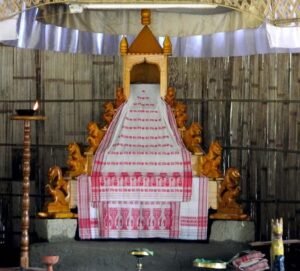
Namghar, rooted in Assam, to be inuagarated at Sarhad, Pune, on 30th Sept 2026
Pune,Rongili Barta- A traditional Namghar, the community institution at the heart of Assam’s Neo-Vaishnavite tradition, will be inaugurated at the Sarhad Gujarwadi Katraj campus here as part of an initiative to strengthen cultural and emotional ties between Assam, Maharashtra and other parts of the country.
The Namghar has been established at the campus of Sarhad Pune, an organization working in the conflict-affected border regions of India.
The Namghar is a traditional place of prayer, community interaction and cultural expression, wh8ch today stands in every village and urban locality across Assam, was pioneered by 15th-16th century Assamese saint and social reformer Srimanta Sankaradeva as part of the Neo-Vaishnavite movement.
Sanjay Nahar, founder-president of Sarhad Pune, said the Namghar would be more than a place of worship, and would serve as a centre for cultural exchange and national integration.
“We want this Namghar to become a spiritual and cultural home for people from Assam and the Northeast living in Maharashtra, while also becoming a bridge through which people in Maharashtra can understand the rich cultural traditions of the Northeast,” Nahar said.
He said the Namghar will be formally inaugurated by noted Vaishnavite scholar Dr Pitambar Deva Goswami, who is the Satradhikar of Sri Sri Auniati Satra in Majuli, a riverine island in Assam, and berve-centre of Assamese art, culture and spirituality.
Noted Sankaradeva scholar, journalist and author Dr Samudra Gupta Kashyap, who is currently Chancellor of Nagaland University will also be present at the inauguration of the Namghar on September 30.
“India’s unity does not mean uniformity. Our strength lies in the diversity of our traditions. The Namghar represents an important Assamese socio-cultural tradition, and bringing it to Pune is an effort to celebrate that diversity while strengthening our common national identity,” Nahar said.
The Namghar tradition emphasises collective prayer, community participation and social equality, with devotees traditionally gathering around the Guru Asana.
Nahar said establishment of the Namghar would also highlight the similarities between Assam’s Neo-Vaishnavite tradition and Maharashtra’s Bhakti and Warkari traditions.
“Srimanta Sankaradeva and the saints of Maharashtra spoke to ordinary people through devotion, music, literature and community participation, in the process celebrating the one-ness of Bharatavarsha. There is a beautiful cultural dialogue waiting to happen between these traditions,” he said.
The Namghar at Sarhad is also envisaged as a cultural and performing arts centre, where Borgeet, Dihanaam, Bhaona, Sattriya dance and other traditional art forms can be presented from time to time.
“We want the Namghar to be a living classroom. It should not remain a static structure. Students should experience the music, theatre, dance, philosophy and community traditions associated with it,” Nahar said.
“Students from Assam should feel at home here, while a students from Maharashtra should feel curious enough to learn about Assam. That exchange is the essence of national integration,” Nahar said.
The Namghar, organisers said, is also intended to evolve as a space where spirituality, culture, education and social interaction converge, reinforcing Sarhad’s larger objective of building bridges across India’s diverse regions.
Sarhad, as part of strengthening national integration, had in 2012 aso instituted a national award in the memory of Bhupen Hazarika.