
Quit India: The Moment India Refused to Wait
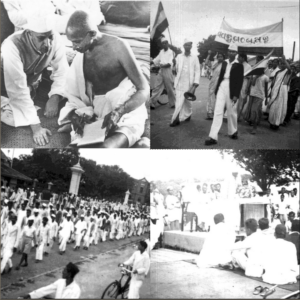
On August 8, 1942, India’s freedom struggle entered its most uncompromising phase. At the Gowalia Tank Maidan in Bombay, the All-India Congress Committee adopted the Quit India resolution, and Mahatma Gandhi issued the call to “Do or Die”. Within hours, the colonial government arrested Gandhi and the Congress leadership. Yet the arrests did not extinguish the movement. They transformed it into a mass uprising in which students, workers, women and ordinary citizens carried the demand for freedom into towns and villages.
Its immediate context mattered. India had been dragged into the Second World War without the consent of its elected representatives. The Cripps Mission of March-April 1942 had offered constitutional proposals for the post-war period, but failed to satisfy the Congress demand for immediate political authority. The failure convinced Gandhi and Congress leaders that postponing freedom was no longer acceptable. On July 14, 1942, the Congress Working Committee adopted a resolution demanding British withdrawal; on August 8, the AICC endorsed the call.
The British response was swift and severe. Gandhi and other national leaders were arrested on August 9, before they could organise the campaign. Gandhi was detained at the Aga Khan Palace until May 1944; his close aide Mahadev Desai died there on August 15, 1942, while Kasturba Gandhi died in detention in February 1944. The Government arrested more than 10,000 people, while censorship and force were used to suppress protests.
Yet the most important fact about 1942 is that the movement survived without its leaders.
Underground networks emerged across the country. Young activists such as Aruna Asaf Ali, Jayaprakash Narayan, Ram Manohar Lohia and Achyut Patwardhan helped sustain resistance. Secret publications circulated despite censorship. Strikes, demonstrations and boycotts spread. In some places, anger turned violent, with attacks on police stations, railway lines, post offices and communication infrastructure. Gandhi remained committed to non-violence, but the repression and absence of central leadership produced a movement whose local expressions were not uniformly controlled.
The geographical spread was significant. Parallel administrations emerged in places such as Ballia in Uttar Pradesh, Tamluk in Bengal and Satara in Maharashtra.
Women played an important role. Aruna Asaf Ali became an enduring symbol of resistance after hoisting the national flag at Gowalia Tank on August 9. Across regions, women organised meetings, distributed underground literature, faced arrest and sustained local mobilisation. Students, too, were central to the movement. In Assam, for instance, young people participated actively in underground resistance. In Barpeta and other areas, student groups formed “Mrityu Bahinis”, or death squads, reflecting the extraordinary intensity of nationalist mobilisation.
Assam’s experience deserves greater attention in the national memory of 1942. The State witnessed protests, arrests, underground activity and sacrifices that demonstrated that the movement was not confined to the political centres of Bombay, Delhi or Calcutta. The courage of young Assamese participants, including Kanaklata Barua, illustrates how the call for freedom travelled into rural and peripheral India.
Quit India was not militarily decisive. The British Empire did not collapse in 1942, and the movement was suppressed by 1944. Independence in 1947 resulted from several forces, including the Indian National Army, the post-war political crisis, the Royal Indian Navy mutiny, changing international conditions and Britain’s weakening capacity to sustain empire.
But Quit India changed the political equation irreversibly.
It demonstrated that British rule could no longer depend upon passive Indian acceptance. The colonial state could imprison leaders, censor newspapers and deploy force, but it could not restore the legitimacy it had lost. When Britain eventually negotiated the transfer of power, the question was no longer whether India should become free, but how and when.
The people who joined Quit India did not know that independence was only five years away. They acted without that certainty. They accepted imprisonment, violence, economic hardship and, in many cases, death because freedom could not remain an indefinitely postponed promise.
For contemporary India, remembering Quit India should not mean converting history into ritual. It should encourage a more demanding understanding of freedom: political independence must be accompanied by constitutional morality, democratic participation, civil liberties and social responsibility. The courage to question authority is essential, but so is protecting institutions and the rights of those with whom one disagrees.
The August Movement was ultimately a declaration that Indians would no longer wait for freedom to be granted. Its enduring significance lies precisely there. Independence was won not by the generosity of an empire, but by the persistence of a people who made continued foreign rule increasingly impossible.
Siddharth Roy
Guwahati, Assam