
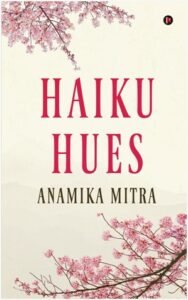
Haiku Hues: Small Poems, Expansive Worlds
Review by Anurag Talukdar
Haiku Hues, a collection of one hundred haikus by Anamika Mitra, is a noteworthy addition to contemporary poetry. An established and widely respected voice, Mitra takes on the challenge of sustaining an entire collection within one of the most minimal poetic forms, and does so with quiet confidence.
At the outset, she makes it clear that she is not strictly bound by the classical 5-7-5 syllabic structure traditionally associated with haiku. This creative liberty works in her favour. Rather than being constrained by form, the poems breathe freely, allowing emotion and imagery to take centre stage.
What stands out most in this collection is its thematic diversity. The haikus move effortlessly from nature to everyday life, from intimate human moments to broader reflections on existence. A fleeting scene in a restaurant may sit comfortably alongside a meditation on mortality, and yet the transitions never feel jarring. Instead, they mirror the fragmented yet interconnected nature of lived experience.
Adding another layer to the reading experience are the illustrations by the poet herself. These drawings, ranging from delicately sketched floral forms to intricate mandala-inspired patterns, are a visual treat in their own right. The fine detailing and symmetry, particularly in the mandala work, create a sense of calm and contemplation that complements the brevity of the haikus. Rather than merely accompanying the poems, these illustrations deepen the reader’s engagement, offering a visual pause that mirrors the reflective nature of the verses.
One of the most striking haikus in the collection reads:
Hospital bed
What use is power and wealth
I cannot barter death.
In just three lines, Mitra captures the ultimate leveller of human existence. The poem is stark, direct, and leaves behind a lingering sense of quiet reflection.
In contrast, another haiku turns towards the complexities of love:
Love is pure
Love is sacred
Can love be forbidden
Here, the poet moves from assertion to question, gently unsettling the reader. The simplicity of the lines belies the depth of the thought they provoke, making it one of the more memorable pieces in the collection.
A third haiku demonstrates her strength in visual imagery:
Setting sun
Woman widowed
The sinking red dot
This piece is evocative and layered, using minimal words to suggest loss, transition, and cultural nuance. It is in such moments that Mitra’s ability to say more with less becomes most evident.
At times, the poet’s preference for creative freedom over strict structure gives the haikus a conversational ease, making them feel immediate and accessible. This fluidity may resonate differently with different readers, but it also adds to the collection’s openness, allowing each poem to be experienced in a personal and unrestrained way.
Haiku Hues is ultimately a collection that invites slow reading. It is not meant to be rushed through, but to be paused over, revisited, and felt. In a world of excess, these brief poems offer a welcome return to brevity, reflection, and the quiet power of suggestion.
About the Reviewer:Anurag Talukdar is a Senior Director of Global Operations at anMNC based in Bangalore. He is also a veteran poet, management author, and editor of the Morning Koffee anthology.