
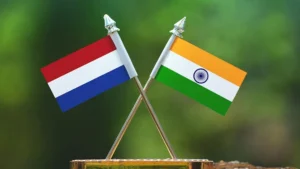
India and the Netherlands: Building a Strategic Partnership for the Future
Siddharth Roy
Civil Engineer, Short Story Writer,
Columnist, Consultant (invitee) to Rashtriya Raksha University
(under the Ministry of Home Affairs, Government of India)
and a Contemporary Affairs Commentator.
Prime Minister Narendra Modi’s recent visit to the Netherlands may not have generated the dramatic headlines often associated with summit diplomacy, yet it could prove to be one of India’s most consequential engagements with Europe in recent years. The visit elevated India-Netherlands ties to the level of a “strategic partnership” and produced 17 concrete outcomes spanning semiconductors, renewable energy, water management, higher education, mobility, health, customs cooperation and agriculture.
At a time when the world is grappling with fractured supply chains, climate emergencies, energy insecurity and geopolitical uncertainty, the significance of this partnership lies not merely in symbolism but in practical cooperation. The Netherlands may be geographically small, but it is one of Europe’s leading centres of technology, logistics, water engineering and innovation. India, on the other hand, represents scale, market potential and a rapidly expanding technological ecosystem. Together, the two countries are attempting to build a partnership that is future-oriented and resilient.
Among the most significant outcomes of the visit was the roadmap for the India-Netherlands Strategic Partnership for 2026-2030. This is important because India’s engagement with Europe is increasingly shifting from transactional trade ties to long-term strategic cooperation. The Netherlands occupies a vital position in Europe’s economic architecture. Rotterdam is Europe’s largest port, Dutch companies are global leaders in semiconductor technology, and the country has pioneered innovative solutions in climate adaptation and sustainable agriculture.
One of the key highlights of the visit was the semiconductor agreement between Tata Electronics and Dutch firm ASML to support India’s semiconductor fabrication project in Dholera, Gujarat. In an era where semiconductors determine technological sovereignty, India’s attempt to build domestic manufacturing capabilities has become a strategic necessity. The COVID-19 pandemic and global geopolitical tensions exposed the vulnerabilities of concentrated semiconductor supply chains. By partnering with the Netherlands, India seeks access not only to advanced technology but also to trusted supply networks.
Equally important was the emphasis on green energy and climate transition. The two countries agreed on a roadmap for green hydrogen cooperation and established joint mechanisms on renewable energy and energy transition. India’s ambitious clean-energy targets require international technological collaboration, financing and research support. The Netherlands, with its expertise in offshore wind energy and sustainable industrial systems, can become an important partner in India’s energy transition journey.
Perhaps the most strategically relevant aspect of the visit for India’s future lies in water management cooperation. Prime Minister Modi’s visit to the iconic Afsluitdijk dam in the Netherlands underlined India’s growing interest in Dutch expertise in flood control and coastal engineering. The Letter of Intent concerning technical cooperation on Gujarat’s Kalpasar project demonstrates India’s intention to learn from Dutch innovations in managing water resources.
This cooperation is particularly relevant for flood-prone States such as Assam and Bihar. Assam Chief Minister Himanta Biswa Sarma himself noted that Dutch water governance models could be useful for Assam’s riverine challenges. With climate change intensifying floods, river erosion and sea-level rise, India must invest heavily in climate-resilient infrastructure. The Netherlands offers lessons in long-term planning, scientific water governance and integrated infrastructure management.
Agriculture and dairy cooperation also emerged as important pillars of the partnership. The establishment of Indo-Dutch Centres of Excellence in flowers and dairy training reflects the Netherlands’ globally recognised strengths in agricultural innovation. Despite limited land availability, the Netherlands has become one of the world’s largest agricultural exporters through advanced technology and efficient farming methods. India can benefit significantly from such expertise, especially in improving productivity, cold-chain systems and sustainable farming practices.
The visit also focused on people-to-people and academic ties. Agreements on higher education, migration and mobility, and cooperation between Indian and Dutch universities indicate that the relationship is expanding beyond government-to-government engagement. Skilled mobility partnerships are becoming increasingly important in a world facing demographic imbalances and talent shortages. India’s large skilled workforce and the Netherlands’ demand for high-quality professionals create natural complementarities.
Another noteworthy aspect was the cultural dimension of the visit. The restitution of the Chola copper plates to India carried symbolic importance. In recent years, India has intensified efforts to recover stolen cultural artefacts from abroad. Such gestures strengthen trust and cultural goodwill between nations.
The broader geopolitical context also explains the importance of the visit. Europe today is seeking to diversify economic and strategic partnerships amid uncertainties created by the Ukraine conflict, tensions with China and disruptions in global supply chains. India, meanwhile, is expanding its partnerships with European countries while maintaining strategic autonomy. The India-Netherlands partnership fits into this larger realignment.
Importantly, the visit signals India’s growing emphasis on issue-based diplomacy rather than ideological alignment. Cooperation in semiconductors, critical minerals, renewable energy, logistics and technology reflects India’s pragmatic foreign policy priorities.
However, declarations alone do not guarantee success. Many bilateral agreements announced during high-level visits often remain under-implemented. The true test of this strategic partnership will lie in institutional follow-up, investment flows, technology transfer and project execution. India must ensure that such agreements translate into tangible domestic gains, especially in infrastructure, manufacturing and climate adaptation.
Prime Minister Modi’s Netherlands visit demonstrated that diplomacy today is increasingly about building partnerships for future challenges rather than merely managing present crises. In a fragmented and uncertain world, India’s engagement with technologically advanced and innovation-driven countries like the Netherlands can strengthen its developmental ambitions and strategic resilience.
The visit may not have dominated global headlines, but its long-term significance could be substantial. In many ways, India and the Netherlands are attempting to craft a partnership that reflects the priorities of the 21st century i.e. sustainability, technological cooperation, resilient supply chains and climate preparedness. That makes this visit not merely successful, but strategically timely.