
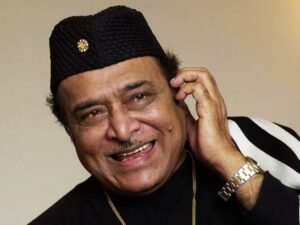
The Global Legacy of ‘Bharat Ratna’ Dr Bhupen Hazarika
[Tracing his remarkable journey from the banks of the Brahmaputra to the cultural capitals of New York and Moscow, Dr Bhupen Hazarika’s autobiographical masterpiece,“Moi Eti Jajabor”, remains an enduring call for empathy, solidarity, and world peace.This legendary Indian maestro, poet, composer, filmmaker, and humanist elevated regional folk traditions into timeless anthems of global solidarity and peace.]
Few figures in modern cultural history have embodied the ideal of the Renaissance humanist as completely as Bharat Ratna Dr Bhupen Hazarika. Revered across South Asia as the Sudhakantha (the nectar-voiced bard) and the ‘Bard of the Brahmaputra,’ Hazarika was far more than a legendary singer and composer. A poet, lyricist, filmmaker, journalist, scholar, cultural diplomat, Dr Hazarika was a tireless conscience keeper for humankind. He was an artist whose creative genius transformed regional folk traditions into a universal language of empathy, justice, and global solidarity.
Born on September 8, 1926, in Sadiya, a frontier town nestled in the easternmost corner of Assam, Hazarika grew up surrounded by the majestic rhythms of the Brahmaputra River and the diverse indigenous cultures of Northeast India. His extraordinary gifts were evident early; he recorded his first song at the age of ten and wrote his first lyrics while still in histeens. Yet his vision was never parochial. After completing his master’s degree in political science at Banaras Hindu University, he traveled to the United States in 1949 on a scholarship, earning a PhD in Mass Communication from Columbia University in New York in 1952. His doctoral dissertation exploring the use of audiovisual media in adult basic education foreshadowed a lifelong conviction that art and communication must serve as instruments of social enlightenment.
New York also proved to be a crucible for Hazarika’s international worldview. There, he formed an enduring friendship with the legendary African-American bass-baritone, scholar, and civil rights crusader Paul Robeson. Inspired by Robeson’s conviction that ‘artists are the gatekeepers of truth’ and by the iconic anthem ‘Ol’ Man River,’ Hazarika later composed ‘Bistirno Parore’ an immortal meditation on the mighty Brahmaputra that challenged human indifference to poverty, injustice, and social decay. Through this synthesis of Eastern philosophical depth and global humanistic struggle, Hazarika forged an artistic identity that belonged simultaneously to his native soil and to the entire world.
As a musician and lyricist, Hazarika’s range was breathtaking. Over seven decades, he wrote, composed, and sang more than a thousand songs in Assamese, Bengali, Hindi, and several other languages. Unlike conventional entertainers, he refused to separate melody from moral purpose. In ‘Manuhe Manuhar Babe’ (Humans are for Humans), he posed a timeless ethical question that continues to stir the global conscience: if human beings do not feel for one another, who else will? In ‘Moi Eti Jajabor’ (I am a Wanderer), he rejected the narrow boundaries of geography and nationalism, proclaiming the whole Earth as his home and every stranger as a kinsman. And in ‘Ei Prithibi Ek Krirangan’ (This World is One Arena), he elevated sports into a sanctuary of international peace and harmonious coexistence.
Beyond music, Hazarika’s multifaceted brilliance reshaped Indian cinema and literature. As a pioneering filmmaker, director, and screenwriter, he brought the authentic landscapes, social realities, and indigenous traditions of Northeast India onto the national and international screen through landmark films such as ‘Era Bator Sur’, ‘Shakuntala’, ‘Pratidhwani’, and ‘Chameli Memsaab’. His haunting musical scores for acclaimed films like Rudaali which earned him the Best Music Director honour at the Asia-Pacific International Film Festival in Japan in 1993 demonstrated how deeply rooted folk melodies could move audiences across continents. Simultaneously, as a prolific writer, essayist, and magazine editor, he enriched the Assamese language, earning election as President of the Asom Sahitya Sabha in 1993, and also served as Chairman of Sangeet Natak Akademi.
Hazarika was a cultural bridge-builder in times of historical turmoil. His deep bond with Bangladesh, where his stirring anthems inspired millions during the 1971 Liberation War, earned him the prestigious Friends of Liberation War Honour in 2011. Across borders and communities, he used his resonant baritone to heal divisions, celebrate indigenous tribal and folk heritage, and affirm the dignity of marginalized working people. In 2019, the Government of India posthumously conferred upon him the Bharat Ratna, the nation’s highest civilian award, cementing his place among the foremost architects of modern Indian and world culture.
As the world marks his birth centenary, Dr Bhupen Hazarika’s message speaks with renewed urgency to an era fractured by geopolitical conflict, cultural alienation, and ecological anxiety. He taught humanity that true greatness lies not in power or wealth, but in compassion; not in erecting walls, but in building bridges of shared song. Through his words, melodies, and boundless love for humankind, Dr Bhupen Hazarika remains an eternal beacon reminding people everywhere that we are fellow travellers on a single earth, bound by a common destiny.
Author:
Dr. Surjya Kanta Hazarika
President, Dr. Bhupen Hazarika Cultural Trust