
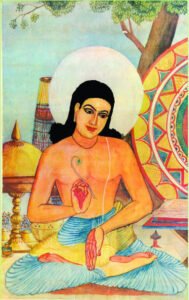
The Beacon of Egalitarianism: Srimanta Sankardeva’s Enduring Legacy
On the auspicious occasion of Srimanta Sankardeva Tithi, Assam and the nation pay homage to one of the most transformative figures of Indian history. Srimanta Sankardeva (1449–1568) was not merely a saint, poet, and scholar; he was a polymath who fundamentally reshaped the social, cultural, and spiritual fabric of the Northeast. At a time when medieval society was deeply fractured by rigid caste hierarchies, esoteric rituals, and social fragmentation, Sankardeva spearheaded the Ekasarana Dharma i.e. a neo-Vaishnavite movement rooted in radical equality, devotion, and universal brotherhood. Centuries later, his vision remains a guiding light for a world still grappling with division.
Sankardeva’s genius lay in his ability to weave spiritual reform seamlessly with cultural expression. Recognizing that abstract philosophy alone could not bridge social divides, he harnessed the transformative power of the arts. He created Borgeet, which are devotional songs of sublime lyrical beauty and musical complexity and authored Ankiya Naat, a distinct genre of one-act plays. To bring these dramatic narratives to life, he introduced Sattriya dance and Bhaona (theatrical performances), transforming religion into an immersive, participatory art form. Through these mediums, complex spiritual doctrines were demystified and made accessible to every individual, regardless of caste, creed, or social standing.
Central to Sankardeva’s social architecture was the institution of the Namghar (prayer hall) and the Sattra (monastic center). The Namghar was far more than a place of worship; it was established as a democratic, community-driven institution. It functioned as a village assembly, a cultural theater, a center for dispute resolution, and a sanctuary of social equality. In a Namghar, there were no reserved seats for the privileged; kings and commoners sat side-by-side on simple mats, united in devotion (Nām-Kīrtan). By establishing these decentralized spaces, Sankardeva laid the groundwork for participatory democracy and social cohesion in Assam long before modern democratic institutions were formalized.
At its core, Sankardeva’s philosophy of Ekasarana Dharma preached devotion to a single entity, Lord Krishna, through simple chanting (sravana-kirtana) rather than expensive sacrifices or elaborate priesthood rituals. This simplified spiritual path empowered the marginalized, offering them direct access to the divine without intermediaries. His vision of humanism was broad and inclusive, welcoming people from diverse tribal communities, ethnic backgrounds, and economic strata into a unified cultural fold. He saw the divine spark in every living being, promoting an ethos of non-violence, mutual respect, and environmental harmony.
Furthermore, Sankardeva’s contributions to literature and language transformed the region’s intellectual landscape. Writing in both Assamese and Vrajavali (an artificial literary language designed to reach a broader regional audience across eastern India), he enriched the linguistic heritage of the land. His magnum opus, the translation of the Bhagavata Purana into accessible Assamese, democratized knowledge and gave the people a shared literary identity. His legacy was further nurtured and expanded by his foremost disciple, Madhavdeva, whose unwavering devotion ensured that the flame of this cultural renaissance burned bright across generations.
Today, as we commemorate Sankardeva Tithi, his teachings offer profound relevance for contemporary challenges. In an era marked by rising individualism, social polarization, and cultural erosion, his message of inclusive humanism, community solidarity, and artistic expression serves as a vital antidote. Sankardeva demonstrated that true societal progress cannot be achieved through economic or political means alone; it requires a deep moral and cultural foundation rooted in empathy and mutual dignity.
Srimanta Sankardeva was a giant of the Indian Renaissance whose legacy transcends the borders of Assam. As we honor the Great Master on his Tithi, the most meaningful tribute we can offer is not just to preserve his art, but to actively practice his ideals. By keeping the doors of our hearts open, much like the open doors of a Namghar, we can continue to build a society anchored in justice, equality, and compassion.
Siddharth Roy
Guwahati, Assam