
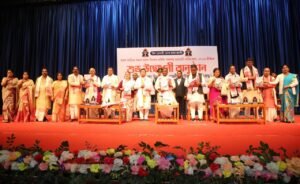
Governor inaugurates the 12th Pancharatna–Guwahati Annual Convention of the Asom Sahitya Sabha
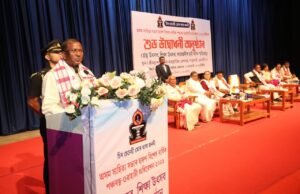
Guwahati,Rongili Barta: Assam Governor Shri Lakshman Prasad Acharya inaugurated the 12th Pancharatna–Guwahati Annual Convention of the Asom Sahitya Sabha at the Mahapurush Srimanta Sankardeva Auditorium in Panjabari.
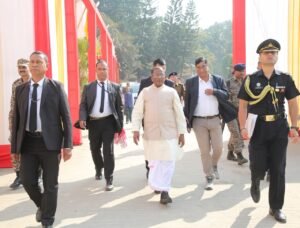
Speaking on the occasion, Governor Shri Acharya expressed a deep sense of pride and joy getting the opportunity to be associated with the prestigious literary congregation. He congratulated the office bearers and members of the Asam Sahitya Sabha for the excellent organisation of the convention and extended his heartfelt best wishes for its success.
Highlighting the antiquity and richness of the Assamese language, the Governor said that Assamese is one of the most ancient languages of India. He noted that Assamese literature represents the vast and continuous body of literary creations composed in the language.
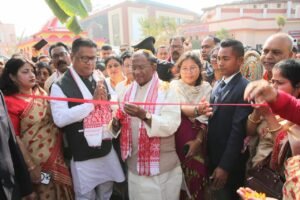
The Governor underlined the unparalleled contribution of the Asom Sahitya Sabha to Assam’s literary, cultural, and intellectual richness. From its inception in 1917 to the present day, the Sabha has not only chronicled Assam’s literary journey but has also provided direction, vision, and intellectual depth. This century-long journey, he said, stands as a living testament to Assam’s cultural consciousness.
Recalling the illustrious legacy of the Assam Sahitya Sabha, the Governor paid tributes to eminent literary figures such as Late Padmanath Gohain Barua, Chandradhar Barua, Kaliram Medhi, Hemchandra Goswami, Lakshminath Bezborua, Rajanikanta Bordoloi, Nilamani Phookan, Ambikagiri Raychoudhury, Dimbeswar Neog, Maheswar Neog, Birendra Kumar Bhattacharya, Nirmal Prabha Bordoloi, Lakshadhar Choudhury, and Homen Borgohain, and others who enriched the institution during their tenure as presidents. He remarked that this proud tradition itself is a chronicle of Assam’s intellectual heritage.
Describing Assamese as a complete and vibrant language, the Governor said it embodies beauty, sensitivity, harmony, devotion, strength, and wisdom, while also resonating with modernity.
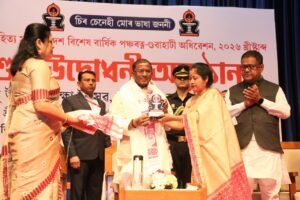
The Governor recalled the profound contributions of great saints such as Mahapurush Srimanta Sankardeva, Sri Sri Madhavdeva, Sri Damodardeva, and Sri Bhattadeva, who carried spiritual knowledge to the masses through the Bhakti movement and transformed literature into a powerful instrument of social awakening.
He also spoke about the historic role of the Assamese language and literature in promoting social justice, giving voice to the marginalized, enriching tribal literature, embracing modern thought, and encouraging new genres such as science fiction. This openness, he said, has kept Assamese literature progressive and dynamic.
The Governor expressed gratitude to Prime Minister Shri Narendra Modi for conferring the status of a Classical Language upon Assamese, stating that this long-awaited recognition has given global acknowledgement to Assam’s rich linguistic heritage.
Emphasising India’s linguistic diversity as a pillar of national unity, the Governor said that language not only reflects the aspirations of the society but also guides it. He cautioned against attempts to create divisions in the name of language and stressed the collective responsibility to embrace, enrich, and connect with all languages.
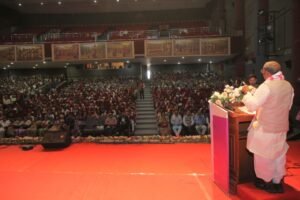
The Governor expressed satisfaction that this year’s Pancharatna–Guwahati Convention is being organised alongside a Book Festival and an Education Festival, symbolising the harmonious confluence of literature, education, and knowledge. He expressed confidence that the Sabha’s sustained efforts for the preservation and promotion of the mother tongue would contribute significantly to building a cultured, enlightened, and developed Assam.
On the occasion, Minister Education Dr. Ranoj Pegu, Minister Sports Smt. Nandita Garlosa, President Asam Sahitya Sabha Dr. Basanta Kumar Goswami, former Vice-Chancellor of Jorhat Women’s University Dr. Malini Goswami, office bearers and members of the Sabha, academicians, writers, litterateurs, and other dignitaries were present.