
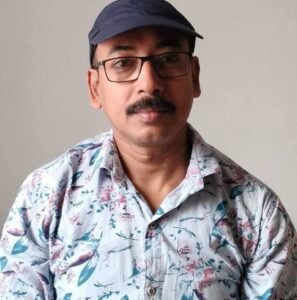
Pradip Nath: A Life in Art, Cartoon, and Conscience
Heramba Nath
(A reflective and deeply human portrait of an artist whose brush and line have consistently engaged with beauty, ethics, and the conscience of society.)
Pradip Nath, celebrated as one of Assam’s most luminous and accomplished artists, illustrators, and cartoonists, was born in the year 1972 in Changsari, a serene and picturesque village nestled in the Kamrup district of Assam. Changsari, with its undulating green fields, meandering streams, and the gentle rhythm of rural life, was more than a mere geographical location—it was a living, breathing classroom for young Pradip. The village unfolded like a painter’s palette: the earthy aroma after monsoon rains, the golden shimmer of sunlight across paddy fields, the chorus of birds at dawn, and the whisper of bamboo groves swaying in the wind. The seasonal rhythm of sowing and harvest, the intimate human interactions, and the quiet rituals of village life instilled in him a deep sense of continuity, harmony, and observation. From an early age, Pradip learned to perceive the extraordinary within the ordinary, to discover beauty not only in the visible landscape but in the ephemeral subtleties of human expression and the unspoken poetry of daily existence. He was talented by birth, naturally gifted with an artistic eye and a reflective sensibility.
Born to Late Nagen Chandra Nath and Maikan Devi, Pradip inherited a lineage steeped in humility, integrity, and moral fortitude. His father, a man of quiet wisdom and disciplined living, instilled in him the values of responsibility and ethical uprightness, while his mother’s nurturing presence offered him patience, love, and moral guidance. The early demise of his father presented young Pradip with responsibilities beyond his years, demanding resilience, self-reliance, and an acute awareness of the fragility and depth of human life. In contrast, his mother’s unwavering support allowed him to navigate this early adversity with compassion and sensitivity. Within this delicate balance of loss, guidance, and emotional nourishment, Pradip cultivated the empathy, attentiveness, and moral consciousness that would later define his artistic philosophy, his professional integrity, and his approach to life itself.
From the earliest years of his childhood, Pradip exhibited a remarkable capacity for observation. Unlike many children preoccupied with fleeting amusements, he lingered over the minute details of life. He noticed the subtle glimmer of sunlight through leaves, the silent conversations etched on villagers’ faces, the rhythm of insects in the monsoon rain, and the faint scent of freshly tilled earth. These observations were not merely aesthetic; they were profoundly ethical, teaching him the impermanence of life, the interconnectedness of all beings, and the quiet rhythms that govern human existence. Drawing and painting became, for him, acts of inquiry and reflection—a means to comprehend the human condition and communicate insights that words alone could not express. These formative experiences cultivated a sensitivity to both visual and emotional subtleties, forming the bedrock of his artistic vision and philosophical depth.
Pradip’s formal education began at Changsari Lower Primary School, where his extraordinary artistic aptitude soon attracted attention. Teachers and peers alike recognised his ability to capture landscapes, human figures, and imaginative scenes with precision and emotional depth. Even in these early years, Pradip was a loving and devoted student, always showing respect and admiration for his teachers, and eager to learn under their guidance. Early encouragement instilled in him the confidence to pursue art seriously, transforming it from a private passion into a vocation suffused with purpose. His continued education at Changsari High School and Changsari Higher Secondary School saw his fascination with art evolve into an ambitious pursuit of creative excellence.
Throughout his high school years, he continued to be a caring, attentive student, deeply appreciating and valuing the guidance of his respected teachers. These years were not merely about refining technique—they were a period of moral, philosophical, and aesthetic formation. Pradip immersed himself in literature, music, and local theatre, cultivating a nuanced understanding of human expression and cultural heritage. The synthesis of rural observation, literary engagement, and formal schooling nurtured a sensibility that married technical skill with reflective thought, empathy, and intellectual depth.
Following his secondary education, Pradip pursued higher studies at Saraighat College, before enrolling at the Government College of Art and Crafts, Guwahati, affiliated with Gauhati University. Here, he undertook the rigorous five-year Bachelor of Fine Arts (B.F.A.) in Painting, graduating with distinction in 1996. These years were transformative both technically and philosophically. Pradip immersed himself in classical and modern art, mastering line, composition, form, and colour, while engaging with the ethical, cultural, and intellectual dimensions of artistic practice. He studied Indian traditional techniques alongside European modernist approaches, striving to harmonise technical mastery with creative expression. During this period, he developed a lifelong conviction that art must serve multiple purposes: aesthetic beauty, moral reflection, cultural continuity, and social engagement. For Pradip, true artistry demanded empathy, intellectual curiosity, and an ethical sensibility capable of addressing the human condition.
Even as a student, Pradip’s instinct for mentorship and education was evident. In 1994, he founded his first art school in Changsari, creating a space where young artists could learn both the technical and ethical dimensions of artistic expression. He personally guided students in brushwork, composition, colour theory, and, critically, in the reflective practice of observing and interpreting life. The school became a hub for experimentation, attracting aspiring artists from surrounding villages who sought not merely to acquire skill, but to cultivate awareness, sensitivity, and social conscience through art. Over time, Pradip entrusted the school’s administration to gifted pupils, confident that they would preserve and honour its guiding philosophy. In 2023, responding to persistent community requests and motivated by his enduring commitment to education, he inaugurated a new art school at Rupkonwar Academy, Changsari, with the support of Principal Abdul Firoz. Through these initiatives, Pradip reinforced his belief that art is not solely an individual pursuit but a shared, transformative endeavour that nurtures talent, fosters cultural literacy, and cultivates moral awareness in the community.
Pradip Nath began his professional career in 1997 as an illustrator for the Assamese daily newspaper Amar Asom, then edited by the eminent litterateur Homen Borgohain. These early years provided rigorous training in both craft and conscience. Working in journalism taught him to distil complex narratives, societal concerns, and public sentiment into immediate, engaging, and thought-provoking visual forms. His illustrations were never mere decoration—they became conduits of empathy, social reflection, and ethical communication. These formative experiences in visual storytelling laid the foundation for a career defined by intellectual rigor, moral reflection, and creative excellence.
From 2001 to 2020, Pradip served as a regular illustrator and cartoonist for Asomiya Pratidin, while also contributing to the weekly Sadin, the monthly Nandini, and the literary magazine Satsori. His creative output flourished during these years, exploring themes of social justice, political turbulence, human suffering, cultural introspection, ethical dilemmas, and the quiet dignity of daily life. His cartoons blended humour with profound empathy, offering critique without alienation. In 2020, he joined The Assam Tribune as a regular illustrator and cartoonist while continuing contributions to Gariyasi, Dainik Asam, and Asom Bani, consolidating his position as one of Assam’s foremost visual commentators on society, culture, and human experience.
Pradip’s contributions in book and magazine cover design are prodigious. From 1994 to 2026, he designed approximately 1000 covers for eminent Assamese literature, collaborating with celebrated writers including Homen Borgohain, Dr. Hiren Gohain, Dr. Rita Chowdhury, Anuradha Sharma Pujari, and Dr. Arupa Patangia Kalita. Five of these works received the prestigious Sahitya Akademi Award, reflecting the synergy between his visual interpretations and literary essence. Each cover is a deliberate, considered composition, translating intricate narratives, themes, and moods into visual language that deepens the reader’s engagement with the text. Through these works, Pradip exemplifies a rare ability to bridge literature and visual art, elevating the written word through the power of image.
His versatility extends into animation and telefilms, reflecting his capacity to integrate imagination, technical skill, and cultural storytelling. Notable works include the animated project Bubu’s Dream (2001) for Doordarshan, Guwahati, inspired by a song by Zubeen Garg, and the telefilm A Japanese Girl, directed by Manju Bora for Doordarshan, Delhi. These projects translated literary and musical expression into visual narratives, blending rhythm, symbolism, and ethical reflection. His animation work demonstrates a commitment to creating art that communicates moral and cultural ideas, rather than simply visual spectacle.
Pradip has also showcased his work internationally, highlighting both the universality and specificity of his vision. He participated in exhibitions in Moscow, Russia, presenting his paintings to collectors, critics, and enthusiasts, where his integration of traditional Assamese motifs with contemporary techniques garnered admiration. At Cairo University, Egypt, he conducted painting workshops, sharing his philosophy and techniques with students and emerging artists, fostering intercultural dialogue and inspiration. His exhibitions in London further confirmed the global resonance of Assamese art and the universal appeal of his creative philosophy.
Domestically, Pradip’s exhibitions at the State Art Gallery, Guwahati have become landmark cultural events. These shows attract critics, art enthusiasts, and distinguished personalities from Assam’s literary, musical, and cultural spheres. Among notable attendees have been celebrated musicians Angaraag Mahanta, popularly known as Papon, and Zubeen Garg, whose presence underscores the admiration Pradip commands across disciplines. Eminent litterateur Homen Borgohain has also attended, signalling the profound connection between Pradip’s art and Assamese literary heritage. Visitors consistently remark on the emotional depth, symbolic resonance, and contemplative quality of his paintings, where every brushstroke, colour, and motif conveys aesthetic beauty alongside ethical and philosophical reflection.
Beyond the canvas, Pradip’s personal presence is enchanting. He often communicates with a mild smile on his lips, a cute expression on his face, and a gentle, endearing talking style. He is naturally charming, approachable, and exudes warmth, making him instantly beloved by students, colleagues, and admirers alike. Whether teaching, mentoring, exhibiting, or engaging socially, he embodies a rare combination of artistic mastery, moral integrity, and personal charisma that commands respect and admiration.
In recognition of his extraordinary contributions, Pradip Nath was awarded the Tarani Kanta Barman Award in 2022, presented by Bimal Bora, then Cultural Minister of Assam. This award honours his artistic excellence, dedication to nurturing talent, and promotion of Assamese culture nationally and internationally. It stands as both recognition of his mastery and affirmation of his lifelong commitment to art as a moral and cultural enterprise.
Pradip’s paintings are distinguished by an expressive and assured brushwork that speaks as much through silence as through colour. His canvases pulse with vibrant hues, yet never descend into mere decoration; each colour is chosen with deliberation, each stroke guided by an inner logic rooted in emotion, ethics, and lived experience. Surrealist elements frequently surface in his compositions, not as stylistic indulgence but as a philosophical language through which he examines the layered realities of human existence. Faces appear contemplative, bodies seem suspended between worlds, and landscapes often blur the boundary between the real and the imagined, reflecting the fragile, uncertain, and deeply vulnerable nature of life itself. Through these visual narratives, Pradip explores themes of human fragility and resilience, the inevitability of mortality, ethical dilemmas that confront society, and the increasingly strained yet inseparable relationship between humans and the natural world.
Among the most recognisable features of his visual language is the recurring motif of three leaves and a branch. This symbol, subtle yet persistent, represents continuity across generations, the quiet resilience of life, and the interconnection between past, present, and future. It suggests growth that is organic rather than forceful, survival rooted in harmony rather than dominance. Equally deliberate is his use of the colour red, which appears across different phases of his work as a signifier of intensity, emotional depth, passion, sacrifice, and vitality. Red in Pradip’s art is never ornamental; it is a pulse, a reminder of life’s urgency and its moral weight. Together, these motifs lend his paintings a contemplative coherence, inviting viewers to pause, reflect, and engage inwardly rather than merely observe.
As a cartoonist, Pradip Nath demonstrates a rare balance of satire, humour, and empathy. His cartoons do not ridicule for the sake of laughter, nor do they moralise with harshness. Instead, they gently yet firmly expose contradictions within society, politics, and human behaviour. With economy of line and clarity of thought, he addresses contemporary social, political, and cultural issues, provoking reflection without alienation. His humour is humanised, often tinged with compassion, allowing even sharp critique to remain accessible and thought-provoking. Through this visual commentary, he creates a space for dialogue and awareness, reminding readers that humour can be a powerful instrument of truth when guided by conscience.
Underlying all of Pradip’s artistic expressions is a deeply held conviction that aesthetic beauty and moral insight are inseparable. For him, art is not an escape from reality but a means of engaging with it more honestly and sensitively. Whether through painting, illustration, or cartoon, his work affirms that visual poetry, ethical questioning, and social responsibility can coexist harmoniously. His art does not shout; it listens, observes, and then speaks with quiet authority, illuminating truths that might otherwise remain unseen.
Through decades of unwavering dedication, Pradip Nath has emerged as one of Assam’s most respected and beloved cultural figures. His journey—from the quiet lanes and rural rhythms of Changsari to the demanding worlds of newspapers, literary circles, international exhibitions, and creative workshops—stands as a testament to the transformative power of talent guided by empathy, moral reflection, and perseverance. He has never severed his roots while reaching outward; instead, he has carried the sensibilities of his birthplace into every sphere he has entered, enriching them with authenticity and cultural depth. His life and work collectively affirm that true artistic success lies not merely in recognition but in sustained integrity and meaningful contribution.
We extend our heartfelt wishes to Pradip Nath for enduring health, creative fulfilment, and personal serenity in the years ahead. May his days continue to be guided by the quiet discipline and inner balance that have long shaped both his life and his art. As time deepens experience, may his vision mature with wisdom, allowing his work to grow ever more contemplative, humane, and resonant with truth. May his integrity, which has remained uncompromised through decades of artistic and professional engagement, continue to stand as a moral compass in a world often tempted by expedience over principle.
May his unwavering dedication to art and education keep inspiring future generations of artists, thinkers, and visual storytellers, encouraging them to pursue creativity not merely as a profession but as a path of responsibility and ethical awareness. Through his mentorship, teaching, and example, may young talents find both confidence and conscience, learning to see the world with sensitivity, empathy, and intellectual honesty. May his art schools, classrooms, illustrations, and canvases continue to function as spaces of learning, reflection, and cultural continuity.
As his work travels beyond geographical and linguistic boundaries, may it further enrich Assam’s cultural landscape while also resonating across borders, speaking to universal human experiences through a distinctly local voice. May his visual language continue to bridge generations, disciplines, and cultures, reinforcing the belief that art rooted in authenticity and compassion can illuminate shared truths. In this enduring journey, may Pradip Nath leave behind a legacy not measured solely by awards or recognition, but by the lives he has touched, the minds he has shaped, and the quiet yet lasting imprint of conscience, beauty, and reflective thought that defines his remarkable contribution to art and society.