
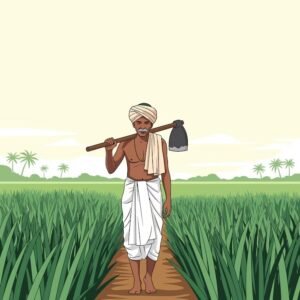
Farmer’s Day: The Silent Backbone of Civilisation and the Unfinished Debt of a Nation
Heramba Nath
Farmer’s Day is not merely a date marked on the calendar; it is a moment of collective pause, a rare opportunity for society to turn its gaze towards those whose labour sustains life itself. Long before cities rose, before industries transformed economies, and before technology reshaped human interaction, agriculture laid the foundation of civilisation. Every grain harvested, every seed sown, and every field tilled represents a continuity of human existence that stretches back thousands of years. Farmer’s Day, therefore, is not about celebration alone; it is about recognition, reflection, and responsibility towards a community that feeds the world yet often lives on the margins of prosperity.
From the earliest settlements along river valleys to the modern mechanised farms of today, farmers have shaped human destiny in ways few other professions have. They domesticated plants and animals, enabling stable communities to emerge. They transformed wilderness into arable land, making food surplus possible and allowing art, science, governance, and culture to flourish. In every civilisation, the farmer stood at the centre of economic and social life, revered as a steward of nature and a provider for society. Yet, as history progressed, this reverence gradually faded, replaced by neglect, exploitation, and indifference. Farmer’s Day serves as a reminder of this forgotten respect and the urgent need to restore dignity to agricultural life.
In contemporary times, the paradox surrounding farmers is stark and troubling. While food security remains one of the most critical concerns for any nation, those responsible for ensuring it often struggle for survival. The hands that feed millions are themselves uncertain of the next meal. This contradiction exposes deep structural inequalities within economic systems that prioritise consumption over production and profit over people. Farmer’s Day forces society to confront this uncomfortable truth and question the moral foundations of its development model.
Agriculture is not merely an occupation; it is a way of life deeply intertwined with culture, tradition, and identity. In rural landscapes, farming rhythms dictate daily routines, festivals, and social bonds. Seasons are not abstract concepts but lived realities, shaping hope and despair alike. The arrival of monsoon rains brings anticipation and relief, while droughts and floods bring anxiety and loss. Farmers live at the mercy of nature, adapting constantly to forces beyond their control. Their resilience in the face of such uncertainty is a testament to human endurance and faith.
Despite technological advances, farming remains one of the most vulnerable professions. Climate change has intensified this vulnerability, introducing unpredictability into weather patterns that farmers once understood intimately. Erratic rainfall, rising temperatures, soil degradation, and water scarcity threaten traditional farming practices across the world. For small and marginal farmers, who lack financial buffers and access to technology, these changes can be devastating. Farmer’s Day is thus also a moment to reflect on environmental responsibility and the need for sustainable agricultural practices that protect both livelihoods and ecosystems.
The economic challenges faced by farmers extend beyond climate-related risks. Market volatility, rising input costs, inadequate infrastructure, and unfair pricing mechanisms often leave farmers trapped in cycles of debt. While global markets determine the price of agricultural commodities, farmers have little control over the value of their produce. Middlemen, supply chain inefficiencies, and policy shortcomings further erode their earnings. In many regions, farmers are compelled to sell their crops at prices that barely cover production costs, undermining the viability of agriculture as a livelihood.
This economic distress has profound social consequences. Rural poverty fuels migration to urban areas, leading to the erosion of traditional farming communities and increasing pressure on cities. Young people, witnessing the struggles of their parents, often abandon agriculture in search of alternative employment. This generational shift raises critical questions about the future of food production and rural sustainability. Farmer’s Day invites reflection on how societies can make agriculture dignified, profitable, and attractive for future generations.
The psychological toll of farming is another aspect often overlooked. The constant uncertainty, financial stress, and social isolation experienced by farmers can lead to mental health challenges. In many countries, alarming rates of farmer suicides highlight the severity of this crisis. These tragedies are not merely personal failures but systemic ones, reflecting a lack of institutional support and social empathy. Observing Farmer’s Day should compel governments and communities to prioritise farmer well-being, recognising mental health as an integral component of agricultural policy.
Women play a crucial yet frequently unacknowledged role in agriculture. Across the world, women are involved in every stage of farming, from sowing and harvesting to processing and marketing. Despite their significant contributions, they often lack land ownership rights, access to credit, and decision-making power. Gender inequality within agriculture perpetuates poverty and limits productivity. Farmer’s Day provides an opportunity to recognise women farmers, amplify their voices, and advocate for policies that ensure equality and empowerment.
The cultural dimension of farming adds another layer of significance to Farmer’s Day. Agricultural traditions, folk songs, rituals, and festivals reflect deep connections between communities and the land. These cultural expressions embody knowledge passed down through generations, offering insights into sustainable practices and ecological balance. As modernisation accelerates, preserving this intangible heritage becomes increasingly important. Honouring farmers also means valuing the cultural wisdom embedded in agricultural life.
Technological innovation has the potential to transform agriculture, improving productivity and resilience. Precision farming, digital platforms, and renewable energy solutions offer new opportunities for farmers to adapt to changing conditions. However, access to technology remains uneven, often favouring large-scale operations over smallholders. Bridging this digital divide is essential to ensure inclusive agricultural development. Farmer’s Day should inspire efforts to democratise technology, making innovation accessible and affordable for all farmers.
Education and extension services play a vital role in empowering farmers. Knowledge about sustainable practices, market trends, and risk management can enhance decision-making and reduce vulnerability. Yet, in many regions, farmers lack access to timely and relevant information. Strengthening agricultural education systems and extension networks is crucial for building resilience and fostering innovation. Farmer’s Day underscores the importance of investing in knowledge as a cornerstone of agricultural progress.
Policy frameworks significantly influence the agricultural landscape. Supportive policies can stabilise incomes, encourage sustainable practices, and protect farmers from market shocks. Conversely, poorly designed policies can exacerbate inequalities and undermine livelihoods. Farmer’s Day should prompt policymakers to engage directly with farmers, understanding their realities and incorporating their perspectives into decision-making. Inclusive governance is essential for creating agricultural systems that are both productive and just.
Globalisation has reshaped agriculture in complex ways. While it has opened new markets and opportunities, it has also exposed farmers to global competition and price fluctuations. Small farmers often struggle to compete with large agribusinesses, leading to consolidation and marginalisation. Balancing global integration with local resilience is a critical challenge. Farmer’s Day encourages reflection on how global food systems can be reoriented to prioritise fairness and sustainability.
Food security remains one of the defining challenges of the twenty-first century. Population growth, climate change, and geopolitical tensions threaten the stability of food supplies worldwide. Farmers stand at the frontline of this challenge, responsible for feeding an ever-growing population under increasingly difficult conditions. Recognising their role is not only a matter of gratitude but of strategic importance. Farmer’s Day highlights the need for long-term investments in agriculture to ensure food security for future generations.
The ethical dimension of agriculture cannot be ignored. The way food is produced, distributed, and consumed reflects societal values. Exploitative practices that prioritise profit over people and planet undermine the moral foundations of food systems. Supporting fair trade, sustainable farming, and ethical consumption is a shared responsibility. Farmer’s Day invites consumers to reflect on their choices and recognise the human stories behind the food they eat.
Community support plays a vital role in strengthening agricultural resilience. Cooperative models, farmer organisations, and local networks enable collective bargaining, knowledge sharing, and mutual support. These social structures can mitigate risks and enhance bargaining power. Encouraging community-based approaches aligns with the spirit of Farmer’s Day, emphasising solidarity and collective action.
The relationship between agriculture and the environment is deeply interconnected. Farmers are both custodians and users of natural resources. Sustainable farming practices can enhance biodiversity, conserve water, and improve soil health. Conversely, unsustainable practices can degrade ecosystems and compromise long-term productivity. Farmer’s Day underscores the importance of aligning agricultural development with environmental stewardship, recognising farmers as partners in conservation efforts.
Urban-rural divides often obscure the realities of farming life. Urban consumers may take food availability for granted, disconnected from the labour and risks involved in production. Bridging this divide requires awareness, education, and empathy. Farmer’s Day serves as a bridge, reconnecting urban societies with rural realities and fostering mutual understanding.
The future of agriculture depends on innovation, inclusivity, and resilience. Climate-smart agriculture, diversified livelihoods, and value addition can enhance sustainability and profitability. Supporting youth engagement in agriculture is particularly important, ensuring continuity and innovation. Farmer’s Day is an opportunity to inspire young people to view agriculture not as a last resort but as a meaningful and viable career.
Honouring farmers also means acknowledging their agency and expertise. Farmers possess deep knowledge of local ecosystems, accumulated through generations of experience. Integrating this indigenous knowledge with scientific research can lead to more effective and context-specific solutions. Farmer’s Day encourages respect for farmer wisdom and collaborative approaches to problem-solving.
Ultimately, Farmer’s Day is a call to action rather than a ceremonial observance. It demands a re-evaluation of societal priorities and a commitment to addressing the systemic challenges faced by farmers. Recognition must translate into tangible support, equitable policies, and sustainable practices. Gratitude expressed in words must be matched by action that improves farmers’ lives.
As the world confronts interconnected crises of climate change, food insecurity, and social inequality, the role of farmers becomes ever more critical. They are not merely producers of food but guardians of landscapes, cultures, and futures. Farmer’s Day reminds humanity of its dependence on those who work the land and the moral obligation to ensure their dignity and well-being.
In acknowledging farmers, society acknowledges its own roots and responsibilities. Every meal consumed is a testament to their labour, patience, and resilience. Farmer’s Day is a moment to remember that civilisation stands on fields tended by unseen hands, and that the prosperity of nations is inseparable from the fate of their farmers. Recognising this truth is the first step towards building a more just, sustainable, and compassionate world where those who feed humanity are themselves nourished by respect, security, and hope.