Assam 2026: BJP Poised for Solo Majority, NDA Heading for Landslide Victory
Rongili Barta- The Bharatiya Janata Party (BJP) poised for third consecutive win(Hat-trick) in the upcoming Assam Assembly elections, securing a third consecutive term in power, according to the latest Tracker Poll-2 conducted by People’s Pulse Research Organization from 9th to 22nd March 2026.
BJP likely to touch simple majority at its own; Congress’ alliance with Raijor Dal will cost the party more as Raijor Dal benefits disproportionately, AIUDF situation improved in lower and middle Assam due to individual factors… This Tracker Poll-2 captures the pulse of Assam’s electorate at a pivotal moment. Dr. Rajan Pandey, Political Analyst and Director of People’s Pulse Research Organization, compiled the report.
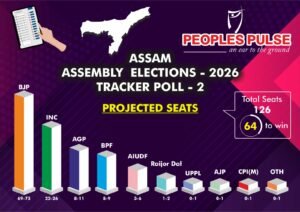
As per the survey conducted by Peoples Pulse research organization the seat projections emerging from the survey present a clear picture of dominance. In the 126-member Assam Legislative Assembly, the BJP is projected to secure between 69 and 73 seats, comfortably crossing the majority mark on its own. This performance highlights a combination of effective governance perception, leadership appeal, and electoral strategy. In contrast, the Indian National Congress (INC) is expected to secure between 22 and 26 seats, reflecting a limited presence that falls significantly short of challenging the ruling party.
The broader strength of the NDA further consolidates this advantage. Alliance partners such as the Asom Gana Parishad (AGP) and the Bodoland People’s Front (BPF) are projected to contribute an additional 8–11 seat and 8–9 seats respectively. Together, the NDA’s tally is expected to approach the 90-seat mark, signalling not just a victory but a decisive mandate. Meanwhile, other political formations including AIUDF, Raijor Dal, UPPL, AJP, CPI(M), and independents are expected to remain on the margins, with limited influence on the overall electoral outcome.
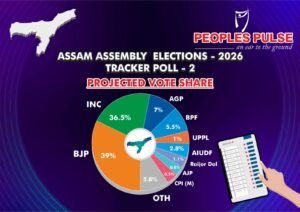
As per the survey conducted by Peoples Pulse research organization interestingly, the vote share projections reflect a more competitive scenario on the surface. The BJP is estimated to secure 39% of the vote, while the Congress trails closely at 36.5%. However, this narrow gap in vote share does not translate into electoral parity. The BJP’s strength lies in its efficient vote distribution and regional consolidation, which allows it to convert votes into seats far more effectively than its rivals. Smaller parties collectively account for the remaining vote share, further fragmenting the opposition space and indirectly strengthening the NDA’s position.
As Assam moves closer to the electoral contest, the data reveals that the BJP is firmly positioned to secure a third consecutive term in power, marking a significant political milestone. The party’s strength lies not only in incumbency but also in its ability to expand its social base and maintain consistent support across diverse voter groups. The National Democratic Alliance (NDA), led by the BJP, appears well on track to secure a comfortable and stable majority, benefiting from both organizational strength and a fragmented opposition.
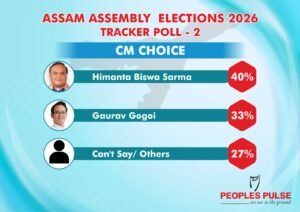
As per the survey conducted by Peoples Pulse research organization Leadership preference continues to play a decisive role in shaping voter behaviour in Assam. The survey clearly indicates that incumbent Chief Minister Himanta Biswa Sarma enjoys a significant edge over his competitors. With 40% of respondents expressing preference for his leadership, he stands well ahead of Congress leader Gaurav Gogoi, who garners 33% support, while others account for the remaining share. This leadership advantage is further reinforced by strong support among women voters and tribal communities, reflecting the Chief Minister’s broad-based appeal and influence across social segments.
A closer look at regional trends reveals the nuanced dynamics shaping the electoral contest across Assam. In Upper Assam, the NDA continues to maintain a stronghold, with a comfortable lead in most constituencies. However, the opposition has shown signs of recovery in select areas. Raijor Dal appears competitive in Sibsagar, while the Congress has improved its position in constituencies such as Nazira, Teok, Titabar, and Jorhat on the north bank. Seats like Doom Dooma are expected to witness close contests, while constituencies such as Sonari and Dergaon may emerge as battlegrounds due to evolving local equations.
In Middle Assam, the political scenario becomes more complex and fluid. Districts such as Nagaon, Hojai, Karbi Anglong, Dima Hasao, and Darrang reflect a mix of competition and shifting alliances. The Congress decision to allocate key constituencies like Dhing and Dalgaon to Raijor Dal, where the latter is relatively weaker, has impacted its electoral prospects. Additionally, anti-incumbency against certain sitting MLAs has created openings for AIUDF, which appears to be gaining ground in specific pockets due to localized factors.
Lower Assam presents another interesting dimension, particularly due to the presence of a significant number of Muslim-dominated constituencies. In this region, AIUDF appears to have improved its position compared to earlier trends, driven largely by individual candidate strengths rather than a broader wave. The party is expected to perform well in constituencies such as Gauripur and Srijangram and is giving competitive fights in seats like Chenga and Dhubri. Despite these localized gains, the overall advantage in the region continues to remain with the NDA.
In the Barak Valley, comprising Cachar, Hailakandi, and Karimganj districts, the BJP maintains an upper hand across a majority of constituencies. However, the Congress is expected to secure a foothold in certain areas, with potential wins in seats such as Sonai, Barkhola, Algapur-Katlichera, and Karimganj South. Karimganj North is likely to witness a closely fought contest, reflecting the competitive nature of the region.
Beyond numbers, the survey identifies several key political trends shaping the electoral narrative. One of the most significant observations is the limited recovery of AIUDF. While earlier trends suggested a decline in its support base, the current findings indicate a modest improvement, driven primarily by individual candidate factors rather than a structural shift in voter sentiment.
Another critical factor is the impact of the Congress–Raijor Dal alliance. The findings suggest that this alliance may have adversely affected Congress more than benefiting it. By conceding strong constituencies such as Dhing and Dalgaon to Raijor Dal, the Congress appears to have weakened its own position while enabling its ally to gain disproportionately. This strategic decision could have a tangible impact on the party’s final tally.
At the same time, the BJP, despite its strong position, is not without challenges. Certain ticket allocation decisions, including accommodating defectors and side lining long-standing party leaders, have created pockets of dissatisfaction. Repetition of unpopular candidates in some constituencies may also affect outcomes at the micro level. However, these challenges appear limited in scope and are unlikely to significantly alter the broader electoral trend.
The emergence of smaller political players adds another layer of complexity to the electoral landscape. Parties such as the Jai Bharat Party, particularly in tea tribe-dominated regions, are expected to play the role of vote splitters. Their presence could influence outcomes in closely contested seats, potentially impacting the BJP more than the Congress in specific constituencies.
The socio-political dynamics underlying these trends further reinforce the BJP’s position. The party has successfully retained its core voter base while expanding its reach among tribal and Other Backward Class (OBC) communities. Its consistent performance in recent elections, including local body polls, autonomous council elections, and the 2024 Lok Sabha elections, has strengthened both its organizational network and voter confidence. At the same time, broader narratives around issues such as illegal immigration and land encroachment continue to influence public opinion, shaping the political discourse in the state.
People’s Pulse Research Organization presents its Tracker Poll–2 for the Assam Assembly Elections 2026, offering a comprehensive and ground-level assessment of the state’s evolving political landscape. Conducted between March 9 and March 22, 2026, this extensive field study captures voter sentiment across regions, communities, and demographics at a crucial pre-election moment. The findings indicate a clear and decisive advantage for the Bharatiya Janata Party (BJP) and its alliance partners, suggesting that the state is witnessing a strong wave of continuity rather than change.
The robustness of these findings is supported by a rigorous methodological framework. The survey employed a purposive stratified random sampling model, covering all 126 Assembly constituencies across 35 districts. A total of 5,000 respondents were interviewed through face-to-face interactions using structured questionnaires, ensuring balanced representation across caste, religion, age, gender, and community. The study was further enriched through consultations with political observers, journalists, and experts, enabling a comprehensive understanding of both micro-level dynamics and the broader electoral context.
In conclusion, the Tracker Poll–2 conducted by People’s Pulse Research Organization presents a clear and consistent picture of the electoral landscape in Assam. The BJP-led NDA holds a decisive advantage, driven by strong leadership, effective governance perception, and a fragmented opposition. While localized factors and alliance dynamics may influence outcomes in select constituencies, the overall trend strongly favours continuity. If these patterns persist, Assam is likely to witness a stable and decisive mandate in favour of the BJP, enabling it to form the government independently for a third consecutive term and marking a significant chapter in the state’s political trajectory.