
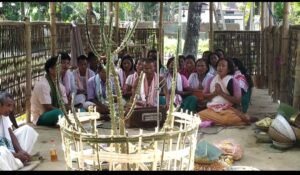
Bathou Puja: Reverence, tradition, and the eternal bond between humanity and nature
Heramba Nath
In the verdant landscapes of Assam, where the Brahmaputra flows with ancient patience and forests breathe history into the present, the Bodo community has preserved a spiritual tradition that speaks quietly yet profoundly about life, morality, and nature. Bathou Puja, the sacred worship of Bathou, the supreme deity of the Bodos, is not merely a ritualistic observance; it is a philosophy of living rooted in harmony, restraint, and reverence. At its centre stands the Siju plant, revered not as an object but as a living presence, symbolising continuity, balance, and the intimate relationship between human existence and the natural world.
The Siju plant, planted carefully in household courtyards, is treated as sacred from the moment it takes root. Its upright posture, thorny resilience, and quiet endurance reflect the moral ideals that Bathou Puja seeks to cultivate within the community. Worshipping a living plant is an affirmation that life itself is sacred, that divinity is not distant or abstract but embedded in the rhythms of nature and everyday existence. Through this simple yet profound act, the Bodo worldview recognises that humanity does not stand above nature but within it.
Bathou Puja is observed with devotion marked by humility rather than spectacle. Offerings of rice, milk, flowers, and traditional items are placed with care, accompanied by prayers that seek well-being, fertility, peace, and moral clarity. These offerings are not transactional gestures; they are expressions of gratitude and responsibility. The ritual reminds participants that prosperity is not merely material abundance but the result of ethical living and harmonious coexistence. In this sense, Bathou Puja transforms everyday domestic space into a site of spiritual reflection, where the sacred and the ordinary merge seamlessly.
The communal character of Bathou Puja is central to its meaning. While households may conduct individual worship, the spirit of the festival is collective. Villages often gather for shared prayers, reinforcing bonds of kinship and mutual responsibility. The festival strengthens social cohesion, reminding individuals that personal well-being is inseparable from collective harmony. Bathou Puja teaches that faith without compassion, and ritual without social responsibility, is incomplete. In doing so, it nurtures a moral culture grounded in empathy, cooperation, and restraint.
Historically, Bathou Puja has evolved through centuries of lived experience, adapting to social change while retaining its ethical and spiritual essence. Passed down orally and through practice, it has served as a repository of collective memory for the Bodo people. The rituals encode lessons about respect for elders, care for the environment, and the importance of balance in all aspects of life. This continuity demonstrates that tradition is not stagnation but a living dialogue between past and present, allowing ancestral wisdom to guide contemporary challenges.
The ecological consciousness embedded in Bathou Puja is especially significant. By centring worship on a living plant, the tradition fosters an ethic of care towards the environment. The Siju plant must be protected, watered, and respected, reinforcing the understanding that life thrives only when nurtured. In a world facing ecological degradation and climate uncertainty, this indigenous wisdom offers a quiet yet powerful reminder that sustainability begins with reverence. Bathou Puja embodies an environmental ethic that arises not from regulation but from spiritual responsibility.
Philosophically, Bathou Puja articulates a vision of life rooted in balance and humility. It teaches that power without responsibility is destructive, and abundance without gratitude is hollow. The rituals emphasise restraint, ethical conduct, and the recognition of limits. In contrast to modern tendencies towards excess and exploitation, Bathou Puja affirms that fulfilment lies in moderation and harmony. The Siju plant, resilient yet unassuming, becomes a moral symbol guiding human behaviour.
Culturally, Bathou Puja serves as a pillar of Bodo identity. In a rapidly changing world where indigenous cultures often face erosion, the festival reinforces a sense of belonging and continuity. It preserves language, ritual practices, and communal memory, ensuring that cultural identity is transmitted across generations. The act of worship becomes an act of remembrance, linking the present to ancestral roots and reinforcing the dignity of indigenous heritage.
Bathou Puja is also deeply connected to agrarian life. Observed in rhythm with seasonal cycles, it reflects gratitude for land, harvest, and sustenance. The prayers offered seek not domination over nature but coexistence with it. This relationship between spirituality and agriculture reinforces an ethic of stewardship, reminding the community that land is not merely a resource but a living entity deserving respect.
Ritual symbolism within Bathou Puja is rich and layered. Coloured threads, flowers, and ceremonial arrangements carry meanings related to protection, purity, and continuity. These symbols function as a language through which complex philosophical ideas are communicated without abstraction. Children learn through observation and participation, absorbing ethical lessons organically rather than through instruction.
Oral traditions associated with Bathou Puja further deepen its cultural significance. Elders recount stories of ancestors, natural forces, and moral dilemmas, embedding ethical reflection within narrative. These stories preserve history while shaping values, ensuring that wisdom is transmitted alongside ritual. The festival thus functions as a living archive, safeguarding both memory and moral vision.
In recent years, Bathou Puja has also received formal recognition at the highest levels of the state, marking a significant moment in the cultural affirmation of indigenous traditions. Prime Minister Narendra Modi has stated that Bathou Dharma has been accorded full respect and recognition, and that Bathou Puja has been declared a state holiday. This acknowledgement represents more than administrative recognition; it symbolises an acceptance of indigenous spiritual traditions as integral to India’s civilisational diversity.
The Prime Minister further noted that under his government a grand statue of the legendary Ahom warrior Lachit Borphukan has been installed, and the statue of Bodofa Upendra Nath Brahma, revered as the father of the Bodo people, has been unveiled. These acts of recognition restore historical balance and dignity to regional icons who shaped Assam’s social and political consciousness. The recognition of Bodofa Upendra Nath Brahma resonates deeply with the ethos of Bathou Puja, as his life and vision were rooted in dignity, identity, and justice for indigenous communities.
Within this broader framework of recognition, Bathou Puja emerges not only as a religious observance but as a symbol of cultural self-respect and historical continuity. State acknowledgement does not alter the spiritual essence of the festival, which remains grounded in humility, nature reverence, and communal harmony. Instead, it affirms that traditions nurtured in village courtyards and forest landscapes possess equal moral worth within the national narrative.
In contemporary times, the relevance of Bathou Puja extends beyond the Bodo community. Its ethical and ecological philosophy speaks to a world grappling with environmental degradation, social fragmentation, and moral uncertainty. The festival challenges the assumption that progress must come at the cost of nature or cultural memory. It offers an alternative vision where development is guided by restraint, respect, and responsibility.
Bathou Puja also exemplifies inclusivity. It does not rely on monumental structures or rigid hierarchies. Worship is accessible, participatory, and rooted in everyday life. This inclusiveness reinforces social equality, teaching that spiritual responsibility belongs to all members of the community.
The resilience of Bathou Puja lies in its adaptability. Despite social change, migration, and modern influences, the core values of the tradition endure. This resilience demonstrates that cultural continuity does not require resistance to change, but clarity of purpose.
At its heart, Bathou Puja articulates a holistic understanding of life. It integrates spirituality with ethics, ecology with community, and memory with responsibility. The worship of the Siju plant becomes a meditation on interdependence, reminding participants that individual actions ripple outward, affecting society and nature alike.
As the Siju plant stands quietly in Bodo courtyards, rooted firmly in the earth and reaching steadily towards the sky, it mirrors the aspirations of a community seeking dignity without arrogance, progress without erasure, and faith without exclusion. Bathou Puja, in its enduring simplicity and depth, offers a lesson of universal relevance: that true civilisation is measured not by what it conquers, but by what it honours, preserves, and nurtures.
In honouring Bathou, the Bodo people affirm a truth increasingly urgent in the modern world—that harmony between humanity and nature is not optional, but essential. Bathou Puja stands as a living reminder that spirituality, culture, and ecology are inseparable, and that the future of society depends upon the wisdom to recognise this unity and live by it.