
Bathow Puja: Faith, Nature and the Living Traditions of Assam
Civil Engineer, Writer and Columnist
Bathow Puja is one of the most important religious and cultural observances of the Bodo community, the largest indigenous group of Assam. Rooted in nature worship and guided by ancient beliefs, Bathow Puja is not merely a ritual but a way of understanding life, harmony and responsibility. In an age of rapid modernisation and cultural homogenisation, this traditional practice stands as a reminder of India’s civilisational depth and the wisdom embedded in indigenous belief systems.
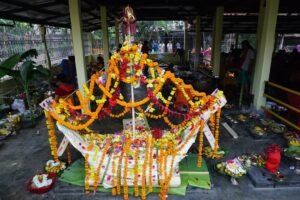
At the heart of Bathow Puja is the worship of Bathow Bwrai, the supreme deity of the Bodos. Bathow is not imagined in human form or housed in grand temples. Instead, the deity is symbolised by the Sijou plant (Euphorbia neriifolia), which is planted in the courtyard of homes or in community spaces. The Sijou plant is protected by a bamboo fence, and offerings are made with simplicity and reverence. This form of worship reflects a worldview in which divinity is inseparable from nature.
The symbolism of Bathow Puja is profound. The Bodo belief system recognises the five basic elements—earth, water, fire, air and space—as the foundation of existence. The Sijou plant, evergreen and resilient, represents life itself. The bamboo fencing around it symbolises protection and order. There are no idols, no elaborate rituals, and no display of wealth. Faith is expressed through humility, discipline and collective participation. In this sense, Bathow Puja offers a quiet contrast to ritual excess and reminds society that spirituality can be simple yet deeply meaningful.
Traditionally, Bathow Puja is performed during important moments in individual and community life—births, marriages, harvests, and times of crisis. It is also observed as a community festival, bringing people together in shared prayer and celebration. The rituals are conducted by elders or priests known as Douri, whose role is not only religious but also social. They act as custodians of tradition, oral history and moral values.
The significance of Bathow Puja extends beyond religion. It plays a vital role in preserving Bodo identity, language and cultural continuity. Songs, chants and prayers offered during the puja are passed down orally from one generation to the next. These traditions strengthen community bonds and ensure that cultural knowledge is not lost. In a region where indigenous cultures have often struggled for recognition, Bathow Puja serves as an assertion of dignity and heritage.
Bathow Puja is also deeply ecological in spirit. Long before environmental conservation became a global concern, indigenous communities like the Bodos practised sustainable living through belief systems that respected nature. Worshipping a plant as a sacred symbol creates a natural ethic of protection and care for the environment. It discourages exploitation and promotes balance between human needs and natural resources. In today’s context of climate change and ecological degradation, such traditions carry valuable lessons.
Over time, Bathow Puja has adapted to changing social realities. While modern education, urbanisation and religious influences have altered aspects of Bodo life, the core values of Bathow worship remain intact. In many places, Bathow Puja is now observed in organised community spaces, often alongside cultural programmes that showcase Bodo dance, music and crafts. This evolution reflects resilience rather than dilution—a willingness to preserve tradition while engaging with the present.
The recognition of Bathow Puja in Assam’s broader cultural landscape is also a step towards inclusive understanding. Assam’s strength lies in its diversity, shaped by multiple ethnic groups, languages and belief systems. Festivals like Bathow Puja enrich this shared space by offering insights into indigenous worldviews that are often underrepresented in mainstream narratives. Respecting such traditions is essential to building a society based on mutual recognition rather than uniformity.
However, challenges remain. Younger generations, especially in urban areas, often feel disconnected from traditional practices. Economic pressures and migration have weakened community structures in some regions. There is a risk that rituals may survive only as symbols, stripped of their deeper meaning. Addressing this requires more than official recognition; it calls for conscious cultural engagement. Schools, cultural institutions and media have a role to play in documenting, teaching and celebrating indigenous traditions with sensitivity and accuracy.
Bathow Puja also invites reflection on the broader idea of Indian spirituality. India’s religious heritage is not limited to scriptures and temples alone. It includes oral traditions, community rituals and nature-based worship that have sustained societies for centuries. Acknowledging this plurality enriches the national narrative and challenges narrow definitions of culture and faith.
As Assam moves forward on the path of development, preserving traditions like Bathow Puja should not be seen as resistance to progress. On the contrary, such practices offer ethical anchors in times of rapid change. They remind us that development must be rooted in respect—for people, for culture and for nature.
Bathow Puja is ultimately a celebration of balance: between the human and the natural, the individual and the community, the past and the present. In honouring Bathow, the Bodo community honours life itself. For the rest of India, understanding and respecting this tradition is an opportunity to rediscover the quiet strength of indigenous wisdom—simple, sustainable and enduring.