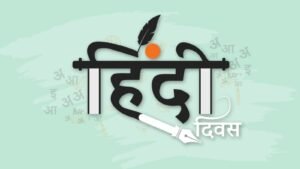
World Hindi Day: A Language that Speaks for a Civilisation
Heramba Nath
Every year on January 10, World Hindi Day is observed across India and in many countries of the world to mark the growing global presence, cultural depth and contemporary relevance of the Hindi language. The observance is not confined to a ritualistic celebration of words and grammar; it is an occasion that invites society to reflect on the journey of a language that has evolved alongside history, absorbed countless influences, and remained deeply rooted in the lived experiences of people. In a world increasingly shaped by speed, technology and linguistic uniformity, World Hindi Day stands as a reminder that languages are living carriers of memory, identity and civilisation.
Hindi occupies a distinctive position within India’s linguistic and cultural landscape. It is not merely a means of communication but a shared emotional space for millions. Spoken, understood or recognised by a large section of the population, Hindi acts as a connecting thread among diverse regions, communities and traditions. Its evolution has been organic rather than imposed, shaped over centuries through interaction between Sanskrit-based traditions and influences from Persian, Arabic, Turkish and later English. This layered development has given Hindi a remarkable flexibility, allowing it to articulate spiritual ideas, literary beauty, political thought and everyday life with equal clarity.
Historically, Hindi grew not within the confines of royal courts or elite institutions alone, but through the voices of common people. Bhakti and Sufi poets used simple, accessible language to communicate profound philosophical ideas. Saints, reformers and freedom fighters employed Hindi to awaken social consciousness and mobilise the masses. During India’s freedom struggle, Hindi became one of the most effective tools of national expression, enabling leaders to reach people across regional and social divisions. Its role during this period reinforced the idea that a language becomes powerful when it belongs to the people.
The global journey of Hindi is closely linked to migration and cultural exchange. Indian communities carried the language to distant lands during the colonial period, where it took root in countries such as Fiji, Mauritius, Guyana, Suriname, Trinidad and South Africa. Over time, Hindi adapted to new environments, blending with local languages while retaining its essential character. In recent decades, the Indian diaspora in Europe, North America and the Middle East has further expanded its reach. Cultural expressions such as Hindi cinema, music, television and literature have played a significant role in familiarising global audiences with the language, even among those who may not speak it fluently.
World Hindi Day also reflects India’s cultural diplomacy. Through international conferences, academic programmes and cultural exchanges, Hindi has gained recognition as one of the world’s major languages. Its inclusion in foreign universities, research institutions and translation projects demonstrates a growing interest in understanding Indian thought, history and society through its language. However, this global recognition brings with it a responsibility to present Hindi not as a rigid or exclusionary symbol, but as a dynamic and inclusive medium of expression.
Within India, the celebration of Hindi must always be accompanied by respect for linguistic diversity. India is home to hundreds of languages and dialects, each representing a unique cultural and intellectual tradition. The promotion of Hindi should never result in the marginalisation of regional languages. Instead, Hindi can function as a bridge language, facilitating communication and understanding while coexisting harmoniously with other tongues. A language thrives through acceptance and usefulness, not through compulsion. When people adopt a language willingly because it enables connection and expression, its strength becomes enduring.
World Hindi Day also invites reflection on the future of the language. As science, technology and global communication advance, languages must expand their vocabulary and conceptual range. Hindi needs continuous enrichment through translation, original research and creative writing so that it remains capable of engaging with modern knowledge systems. Scientific education, legal discourse, journalism and digital content in Hindi require sustained effort and institutional support. Strengthening these areas will ensure that Hindi does not remain confined to cultural expression alone but becomes a robust medium for contemporary thought.
The digital age has opened new avenues for Hindi’s growth. Social media platforms, online news portals, podcasts and video content have created spaces where Hindi thrives in innovative forms. Young users are reshaping the language, introducing new expressions while retaining traditional elements. This evolution should not be viewed with anxiety but with confidence, as it demonstrates the vitality of a living language. A language that adapts to changing times remains relevant and resilient.
Literature continues to be one of Hindi’s greatest strengths. From classical poetry to modern novels, from social realism to experimental writing, Hindi literature reflects the changing realities of society. Contemporary writers are addressing issues such as migration, inequality, identity and environmental concerns, proving that Hindi remains capable of engaging deeply with the complexities of modern life. Encouraging reading, publishing and translation in Hindi is essential for nurturing this literary ecosystem.
World Hindi Day, therefore, is not only about celebrating a language but also about reaffirming the values it carries. Hindi embodies dialogue rather than domination, inclusiveness rather than uniformity, and continuity rather than stagnation. It reminds society that language is not a static inheritance but a shared responsibility, shaped daily by those who speak, write and think in it.
In essence, World Hindi Day offers an opportunity to honour a language that has journeyed through centuries of change while remaining deeply connected to human emotion and social reality. It calls for a balanced approach that celebrates Hindi’s achievements, acknowledges its challenges and respects the multilingual fabric of the nation. By nurturing Hindi with sensitivity, creativity and openness, society ensures that the language continues to serve not only as a means of communication, but as a living expression of a rich and evolving civilisation.