
Modi and Assam: Development, direction and a state reimagined
Heramba Nath
Prime Minister Narendra Modi’s visit to Assam has unfolded as a moment of considerable importance in the State’s contemporary history, reflecting a convergence of political intent, developmental ambition and symbolic reassurance. The launch and inauguration of a wide range of development projects during the visit point towards a sustained effort to reposition Assam within India’s broader growth narrative. More than the announcement of schemes or the unveiling of infrastructure, the visit conveyed a deeper message: that Assam is no longer to be seen as a distant frontier, but as an integral and dynamic participant in the country’s economic, strategic and cultural future.
Assam’s relationship with development has long been complex. Blessed with abundant natural wealth, fertile plains, vast river systems and a cultural heritage of remarkable depth, the State has nevertheless struggled to convert these advantages into sustained economic prosperity. Historical neglect, geographical isolation, inadequate infrastructure, repeated floods and limited industrial expansion have collectively constrained growth. For many years, development in Assam appeared episodic rather than transformative, arriving in fragments rather than as part of a coherent vision. Against this backdrop, Modi’s visit assumes significance as an attempt to signal continuity, scale and seriousness in addressing long-standing gaps.
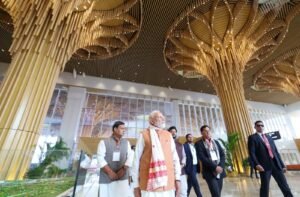
The inauguration of the new terminal building at the Lokpriya Gopinath Bordoloi International Airport in Guwahati emerged as one of the most visible symbols of this renewed emphasis. Airports today are not merely transport facilities; they are statements of aspiration and confidence. They represent how a region presents itself to the world and how prepared it is to engage with global flows of people, ideas and capital. The new terminal, designed to handle more than 1.3 crore passengers annually, marks a qualitative shift in Assam’s aviation infrastructure, both in terms of capacity and conception.
What sets this terminal apart is its deliberate integration of cultural identity into modern design. The architectural theme inspired by bamboo and orchids draws from elements deeply rooted in Assam’s natural and cultural landscape. Bamboo, a material woven into the daily life, crafts and architecture of the region, finds a contemporary expression within a modern infrastructure project. Orchids, emblematic of Assam’s biodiversity, lend aesthetic grace and symbolic meaning. This blending of tradition and technology reflects a broader developmental philosophy that seeks to modernise without erasing identity.
Technological sophistication forms another defining feature of the new terminal. Facilities such as contactless passenger processing, modern security systems, efficient baggage handling and digitised services are aligned with global aviation standards. Improved air connectivity is expected to have a cascading impact across multiple sectors. Tourism, a largely untapped potential in Assam, stands to gain as access to wildlife sanctuaries, cultural festivals and scenic landscapes becomes easier. Business travel and investment are likely to increase, strengthening the State’s economic ecosystem. For ordinary citizens, improved connectivity reduces distances, enhances mobility and reinforces a sense of inclusion within national and global networks.
Beyond aviation infrastructure, the Prime Minister’s visit highlighted industrial development as a central pillar of Assam’s transformation. The foundation stone laying of a major ammonia-urea fertiliser project at Namrup represents a strategic intervention in the State’s agrarian economy. Agriculture continues to sustain a significant portion of Assam’s population, yet farmers have long faced challenges related to input availability, fluctuating prices and dependence on external supply chains. Strengthening domestic fertiliser production addresses these vulnerabilities directly, enhancing agricultural stability and resilience.
The fertiliser project also carries broader economic implications. Large industrial initiatives often function as growth anchors, around which ancillary industries, logistics services and local enterprises develop. Employment generation extends beyond direct jobs to indirect opportunities in transportation, maintenance, construction and support services. For Assam’s youth, many of whom migrate to other States in search of employment, such projects offer the possibility of building livelihoods closer to home. Industrial development, therefore, becomes not only an economic strategy but also a social one, addressing issues of migration, regional imbalance and community stability.
The symbolic aspects of Modi’s visit were equally telling. His homage at the Swahid Smarak Kshetra in Guwahati, paying tribute to the martyrs of the Assam Movement, acknowledged the historical struggles that continue to shape the State’s political consciousness. The Assam Movement remains a defining chapter in the region’s modern history, influencing debates on identity, migration, rights and federal relations. By recognising this legacy, the visit underscored an important principle: development cannot be detached from history. Progress that acknowledges collective memory fosters trust and legitimacy, while progress that ignores it risks alienation and resentment.
Infrastructure development, particularly in roads, bridges and connectivity, formed another critical component of the visit’s broader narrative. Assam’s geography presents unique challenges, with vast river systems, floodplains, hills and forests shaping patterns of settlement and mobility. Roads and bridges in such a context are not merely economic assets; they are lifelines. They connect communities to markets, enable access to healthcare and education, facilitate administrative outreach and play a crucial role during natural disasters. Investments in connectivity therefore carry both economic and humanitarian significance.
Improved road networks reduce travel time and transportation costs, integrating remote and rural areas into the economic mainstream. Farmers gain better access to markets, students find it easier to reach educational institutions, and patients can access medical facilities with greater ease. In a flood-prone State like Assam, resilient infrastructure also enhances disaster preparedness and response. Development that prioritises durability, adaptability and local conditions can significantly strengthen the State’s capacity to withstand environmental shocks.
The focus on connectivity aligns with India’s broader strategic vision for the North-East. Assam’s geographical location positions it as a natural gateway to South-East Asia, making it central to regional connectivity and trade initiatives. Strengthening infrastructure in Assam enhances India’s ability to engage economically and diplomatically with neighbouring countries. In this sense, development projects in Assam extend beyond State boundaries, contributing to national economic integration and regional engagement.
Healthcare and education, though often less visible than large infrastructure projects, remain fundamental to long-term development. The broader thrust associated with the Prime Minister’s visit includes ongoing efforts to expand healthcare infrastructure, improve access to specialised medical services and strengthen educational institutions. Assam’s experience during recent public health crises highlighted the importance of robust local healthcare systems. Investments in hospitals, medical colleges and diagnostic facilities improve health outcomes while reducing the financial and emotional burden on families forced to seek treatment elsewhere.
Education and skill development are equally critical to ensuring that growth is inclusive and sustainable. As infrastructure and industry expand, the demand for skilled and semi-skilled labour increases. Aligning educational curricula with emerging economic needs, strengthening vocational training and improving higher education institutions can help prepare Assam’s youth for new opportunities. Development, in this context, becomes an intergenerational project, shaping not only present livelihoods but future aspirations and social mobility.
Environmental sustainability remains one of the most pressing challenges in Assam’s development journey. The State’s rich biodiversity, wetlands and fragile ecosystems are invaluable assets that also demand careful stewardship. Infrastructure and industrial projects must therefore balance growth with ecological responsibility. The incorporation of natural elements and local materials in projects such as the Guwahati airport terminal reflects an awareness of this imperative. However, long-term sustainability will depend on rigorous environmental assessments, community participation and adaptive planning.
Recurring floods and riverbank erosion underscore the need for climate-resilient development strategies. Infrastructure must be designed to withstand extreme weather events, and planning must integrate environmental risk mitigation. Development that undermines natural systems ultimately weakens economic and social resilience. For Assam, sustainable development is not a luxury but a necessity dictated by geography and climate realities.
From a political perspective, Modi’s visit also carried implications for Centre–State relations. High-level engagement signals a willingness to invest political attention and resources in the region. For a State that has often expressed concerns about neglect and marginalisation, such engagement can foster a sense of inclusion and partnership. It reinforces the idea that development strategies must be responsive to regional contexts rather than imposed through uniform approaches.
The scale and scope of the initiatives associated with the visit point towards a broader narrative of transition. Assam stands at a crossroads where historical challenges intersect with emerging possibilities. The success of these initiatives will depend not only on financial investment but also on effective governance, transparency and community involvement. Development must translate into tangible improvements in everyday life, reflected in better access to services, meaningful employment opportunities, environmental quality and social cohesion.
As the visit concluded, the immediate images were of inaugurated facilities, foundation stones and public addresses. The deeper impact, however, will unfold gradually. Roads will shorten distances, industries will generate livelihoods, airports will connect people and ideas, and institutions will shape future generations. The true measure of success will lie in whether these initiatives empower communities, reduce inequalities and strengthen Assam’s resilience in the face of economic and environmental challenges.
In essence, Modi’s Assam visit represents a moment of renewed intent and direction. It reflects a vision that seeks to place Assam firmly within India’s development mainstream while respecting its unique identity and history. The challenge ahead lies in translating vision into reality, ensuring that promises lead to outcomes and that growth is inclusive, sustainable and rooted in the aspirations of the people. If pursued with sensitivity, accountability and foresight, the initiatives associated with this visit could mark the beginning of a transformative chapter in Assam’s long and evolving journey towards prosperity and self-confidence.